Holi 2026 · Wednesday 4 March 2026
Happy Holi from Laisha
Colour in your home and a golden rabi harvest in your fields.
The days of Holi 2026
- Holika Dahan
- Holi (colours)
Holi 2026 at a glance
- Main day: Wednesday 4 March 2026.
- Year: 2026 CE, Vikram Samvat 2082.
- On the main day in New Delhi: sunrise 06:43, sunset 18:22 IST; Krishna Pratipada at sunrise; nakshatra Purva Phalguni.
- Next year: Monday 22 March 2027, 18 days later in the year than this year.
The panchang for each day of Holi 2026
For New Delhi, in IST. A tithi is the lunar day; it rarely starts at sunrise, so the table gives the tithis that run through each date with their start and end, and the nakshatra at sunrise.
| Day | Sunrise / sunset | Tithi | Nakshatra at sunrise |
|---|---|---|---|
| Holika Dahan Monday 2 March 2026 | 06:45 / 18:21 | Shukla Chaturdashi 19:09 (1 Mar)–17:56; Purnima 17:56–17:07 (3 Mar) | Ashlesha until 07:51 |
| Holi (colours) Wednesday 4 March 2026 | 06:43 / 18:22 | Krishna Pratipada 17:07 (3 Mar)–16:49; Krishna Dwitiya 16:49–17:04 (5 Mar) | Purva Phalguni until 07:39 |
Wednesday 4 March 2026 hour by hour (New Delhi)
Yoga Dhriti until 08:52; karana Kaulava until 16:49. Moonrise 19:20. Moonset 07:02.
Daily periods the engine computes: Brahma Muhurat 05:04–05:53; Abhijit Muhurat 12:09–12:56; Rahu Kaal 12:33–14:00; Yamaganda 08:10–09:38; Gulika Kaal 11:05–12:33; Amrit Kaal (Uttara Phalguni) 00:54 (5 Mar)–02:32 (5 Mar).
| Choghadiya | Day | Night |
|---|---|---|
| 1 | Labh (good) 06:43–08:10 | Udveg (bad) 18:22–19:55 |
| 2 | Amrit (good) 08:10–09:38 | Shubh (good) 19:55–21:27 |
| 3 | Kaal (bad) 09:38–11:05 | Amrit (good) 21:27–23:00 |
| 4 | Shubh (good) 11:05–12:33 | Char (neutral) 23:00–00:32 (5 Mar) |
| 5 | Rog (bad) 12:33–14:00 | Rog (bad) 00:32 (5 Mar)–02:04 (5 Mar) |
| 6 | Udveg (bad) 14:00–15:27 | Kaal (bad) 02:04 (5 Mar)–03:37 (5 Mar) |
| 7 | Char (neutral) 15:27–16:55 | Labh (good) 03:37 (5 Mar)–05:09 (5 Mar) |
| 8 | Labh (good) 16:55–18:22 | Udveg (bad) 05:09 (5 Mar)–06:42 (5 Mar) |
Computed with the Sunyra astronomical engine. Times shift by a few minutes for other Indian cities. No puja muhurta is given here: our engine computes the tithi, the nakshatra, sunrise and sunset, not the window a family or temple chooses for the puja, so follow your local panchang or priest for that.
Where Holi 2026 falls in the farming season
Counted from the sowing windows in Laisha's farming calendar for the tropical and monsoon north (South Asia), which gives sowing by month:
- Cassava: sowing opens in April; 4 March 2026 is 28 days before it opens.
- Sugarcane: sowing opens in January; 4 March 2026 is 62 days into the window.
On the farm in March 2026
Holi falls as the rabi crops ripen: mustard is being cut, wheat is turning gold and the harvest is a few weeks away.
Harvested in March: Rice (dry-season irrigated rice), Pigeon pea, Wheat (cool dry-season wheat), Chickpea, Mustard, Potato (cool-season potato on the plains).
Farming calendar for March 2026 → · Laisha Lens: this month →
Colours from the field: natural Holi colours and the plants behind them
Before synthetic dyes, Holi colours came from plants, and many families are going back to them. In early March 2026 several of the traditional colour plants are in season or easy to find in a kitchen.
The classic Holi colour is the saffron-orange of tesu, the flowers of the flame-of-the-forest tree, palash (Butea monosperma), which blooms on bare branches across central and northern India exactly at Holi time. The dried flowers are soaked overnight or boiled in water to give a bright orange-yellow liquid colour. Turmeric (haldi), mixed with gram flour or another fine flour, makes a yellow powder. Beetroot gives pink to magenta, and dried and powdered flowers of marigold give yellow-orange. Henna leaves, dried and powdered, give a green powder, though on skin they stain orange. Indigo, from Indigofera, was the traditional blue.
Why the switch back? Some cheap synthetic Holi powders sold loose have been found to contain industrial dyes, and some coloured pastes have contained metal compounds, which can irritate skin and eyes. Plant colours are gentler, though anyone can still be allergic to a plant, so a skin test on a small patch is sensible.
Palash itself is an interesting farm tree. It grows on poor, dry soils, its leaves are stitched into the leaf plates and bowls used at weddings and temples, and its trees are one of the hosts on which the lac insect is raised. Lac cultivation, in which forest-dwelling farmers infect palash, kusum or ber trees with lac insects and harvest the resin they secrete, is an important source of cash income in Jharkhand, Chhattisgarh and neighbouring states.
Keeping some colour plants on a farm boundary, palash, marigold or a turmeric patch, gives a family its own Holi colours and something extra to sell in a season of high demand.
Sources: ICAR-National Institute of Secondary Agriculture (lac) · Kew Plants of the World Online: Butea monosperma
Send a greeting
A card for your family, friends and fellow farmers.
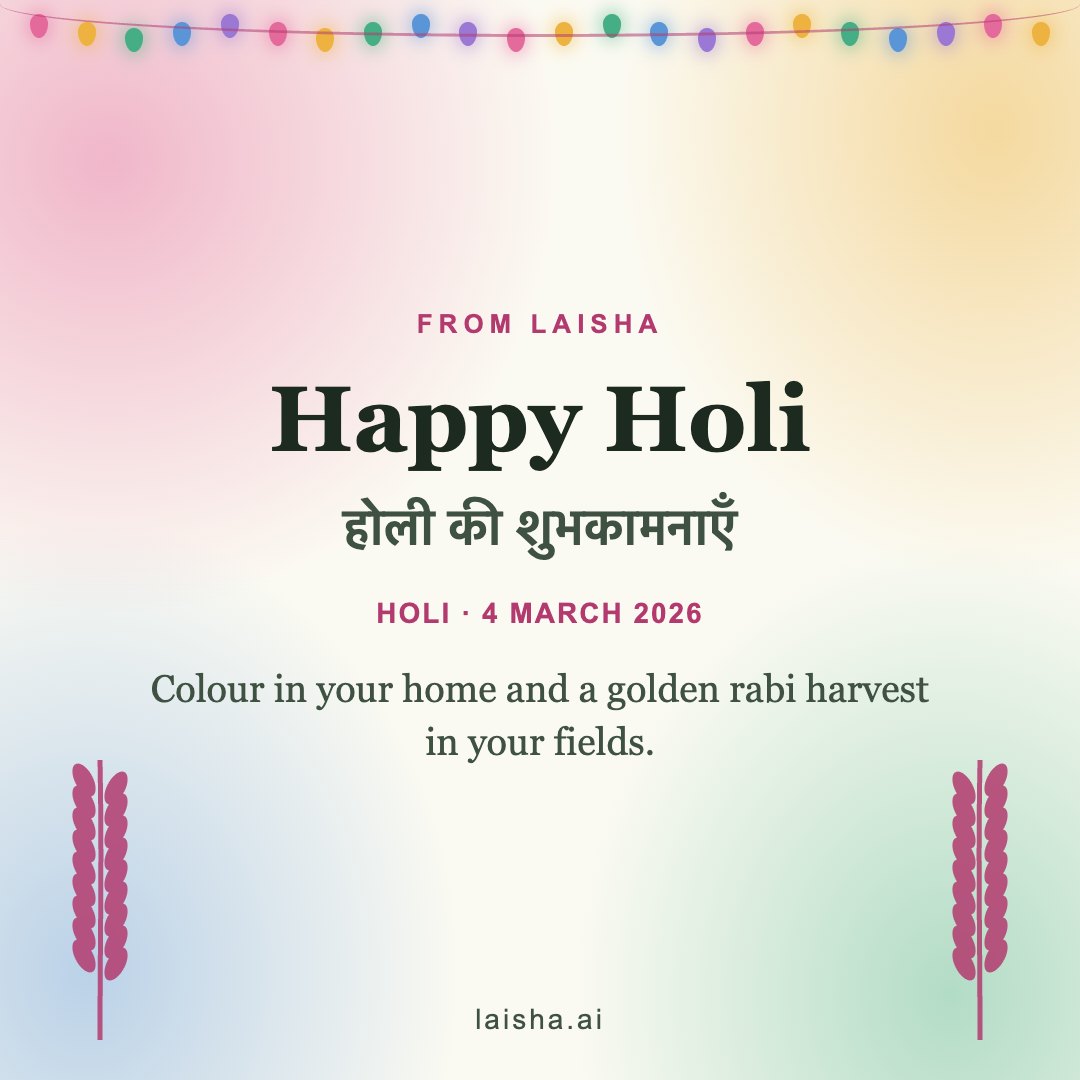
होली की शुभकामनाएँ
घर में रंग और खेतों में सुनहरी रबी फ़सल।
होली 2026 के दिन
- होलिका दहन
- होली (रंग)
मार्च 2026 में खेत पर
होली तब आती है जब रबी की फ़सल पकती है: सरसों कट रही होती है, गेहूँ सुनहरा हो रहा होता है और कटाई कुछ ही हफ़्ते दूर होती है।
मार्च में बुआई (दक्षिण एशिया जैसी उष्णकटिबंधीय, मानसूनी जलवायु): गन्ने।
शुभकामना भेजें
More festivals
- Makar Sankranti 2026Wednesday 14 January 2026
- Eid al-Fitr 2026Saturday 21 March 2026
- Eid al-Adha 2026Thursday 28 May 2026
- Janmashtami 2026Friday 4 September 2026
- Navratri and Dussehra 2026Tuesday 20 October 2026
- Diwali 2026Sunday 8 November 2026
- Christmas 2026 and New Year 2027Friday 25 December 2026
Last updated · How Laisha writes and checks its pages · Report a mistake