Makar Sankranti 2027 · Friday 15 January 2027
Happy Makar Sankranti from Laisha
A sweet harvest festival to every farming family: til, gur and a good year ahead.
The days of Makar Sankranti 2027
- Lohri
- Makar Sankranti · Pongal
Makar Sankranti 2027 at a glance
- Main day: Friday 15 January 2027.
- Year: 2027 CE, Vikram Samvat 2083.
- On the main day in New Delhi: sunrise 07:15, sunset 17:46 IST; Shukla Saptami at sunrise; nakshatra Revati.
- Compared with 2026: then it was Wednesday 14 January 2026; this year it comes 1 days later in the year.
- Next year: Saturday 15 January 2028, on the same calendar date than this year.
The panchang for each day of Makar Sankranti 2027
For New Delhi, in IST. A tithi is the lunar day; it rarely starts at sunrise, so the table gives the tithis that run through each date with their start and end, and the nakshatra at sunrise.
| Day | Sunrise / sunset | Tithi | Nakshatra at sunrise |
|---|---|---|---|
| Lohri Thursday 14 January 2027 | 07:15 / 17:45 | Shukla Shashthi 13:02 (13 Jan)–13:59; Shukla Saptami 13:59–14:13 (15 Jan) | Uttara Bhadrapada until 23:19 |
| Makar Sankranti · Pongal Friday 15 January 2027 | 07:15 / 17:46 | Shukla Saptami 13:59 (14 Jan)–14:13; Shukla Ashtami 14:13–13:43 (16 Jan) | Revati until 23:51 |
Friday 15 January 2027 hour by hour (New Delhi)
Yoga Shiva until 16:18; karana Vanija until 14:13. Moonrise 11:17. Moonset 00:35 (16 Jan).
Daily periods the engine computes: Brahma Muhurat 05:27–06:21; Abhijit Muhurat 12:09–12:51; Rahu Kaal 11:11–12:30; Yamaganda 15:08–16:27; Gulika Kaal 08:33–09:52; Amrit Kaal (Revati) 21:24–23:02.
| Choghadiya | Day | Night |
|---|---|---|
| 1 | Char (neutral) 07:15–08:33 | Rog (bad) 17:46–19:27 |
| 2 | Labh (good) 08:33–09:52 | Kaal (bad) 19:27–21:08 |
| 3 | Amrit (good) 09:52–11:11 | Labh (good) 21:08–22:49 |
| 4 | Kaal (bad) 11:11–12:30 | Udveg (bad) 22:49–00:30 (16 Jan) |
| 5 | Shubh (good) 12:30–13:49 | Shubh (good) 00:30 (16 Jan)–02:11 (16 Jan) |
| 6 | Rog (bad) 13:49–15:08 | Amrit (good) 02:11 (16 Jan)–03:52 (16 Jan) |
| 7 | Udveg (bad) 15:08–16:27 | Char (neutral) 03:52 (16 Jan)–05:33 (16 Jan) |
| 8 | Char (neutral) 16:27–17:46 | Rog (bad) 05:33 (16 Jan)–07:14 (16 Jan) |
Computed with the Sunyra astronomical engine. Times shift by a few minutes for other Indian cities. No puja muhurta is given here: our engine computes the tithi, the nakshatra, sunrise and sunset, not the window a family or temple chooses for the puja, so follow your local panchang or priest for that.
Where Makar Sankranti 2027 falls in the farming season
Counted from the sowing windows in Laisha's farming calendar for the tropical and monsoon north (South Asia), which gives sowing by month:
- Sugarcane: sowing opens in January; 15 January 2027 is 14 days into the window.
- Rice (dry-season irrigated rice): sowing opens in November; 15 January 2027 is 290 days before it opens.
- Onion & shallot (dry-season onion): sowing opens in December; 15 January 2027 is 320 days before it opens.
On the farm in January 2027
Makar Sankranti is the winter harvest festival: sugarcane is being crushed, the rabi crops are growing, and in the south the new rice is cooked as Pongal.
Harvested in January: Cotton, Pigeon pea, Potato (cool-season potato on the plains), Tomato (cool dry-season tomato), Sugarcane, Coffee.
Farming calendar for January 2027 → · Laisha Lens: this month →
New jaggery: how gur is made from the winter cane
Pongal is cooked with new jaggery, and Sankranti sweets from Punjab to Karnataka use it. Mid-January is the height of the jaggery season in India: sugarcane harvested in the cool, dry months is richest in sucrose, and small jaggery units (kolhus in the north, alemanes in parts of the south) work through the season beside the fields.
Making gur is simple in principle and skilled in practice. Fresh cane is crushed and the juice is boiled in a series of wide, shallow iron pans over a furnace fired with the dried crushed cane, the bagasse. As the juice heats, impurities rise as scum; traditional makers add plant clarificants such as the mucilage of deola (Hibiscus ficulneus) or okra stems to help gather it, and skim it off. The juice is boiled until it is thick and reaches its striking point, about 118 to 120 °C, then poured into moulds or worked on a cooling floor and set as blocks or cubes.
Juice should be boiled soon after crushing, since cane cut and left standing loses sucrose to inversion, giving darker, softer jaggery that absorbs moisture. Light colour and hardness are what buyers pay for. Some makers use chemical clarifiers to lighten the colour, which food regulators restrict; plant clarificants give a darker but safer product.
Jaggery stores poorly in humid weather. It absorbs water from the air, becomes sticky and can ferment or grow moulds, so it keeps best wrapped in moisture-proof material, and in the monsoon some makers store it in sealed containers.
Several regions are known for their jaggery: Kolhapur jaggery has a Geographical Indication, and Muzaffarnagar in Uttar Pradesh hosts one of the largest jaggery markets in the country. For a cane farmer far from a sugar mill, a jaggery unit can turn the crop into money without waiting for mill payments.
Sources: ICAR-Indian Institute of Sugarcane Research, Lucknow · FAO: Sugarcane processing and non-centrifugal sugar
Send a greeting
A card for your family, friends and fellow farmers.
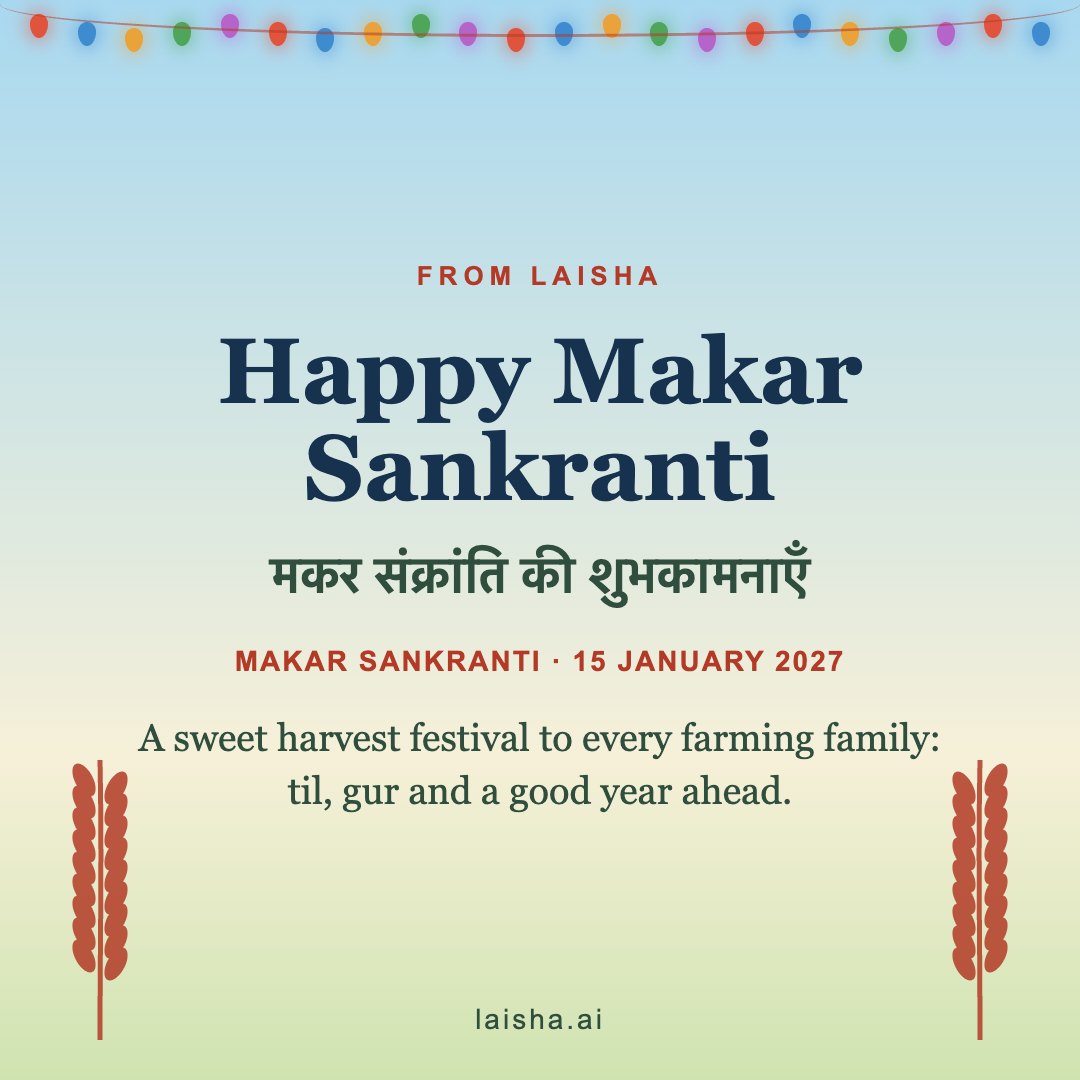
मकर संक्रांति की शुभकामनाएँ
हर किसान परिवार को फ़सल उत्सव की मीठी शुभकामनाएँ: तिल, गुड़ और आगे एक अच्छा साल।
मकर संक्रांति 2027 के दिन
- लोहड़ी
- मकर संक्रांति · पोंगल
जनवरी 2027 में खेत पर
मकर संक्रांति सर्दियों का फ़सल उत्सव है: गन्ने की पेराई चल रही होती है, रबी की फ़सलें बढ़ रही होती हैं, और दक्षिण में नए चावल से पोंगल बनता है।
जनवरी में बुआई (दक्षिण एशिया जैसी उष्णकटिबंधीय, मानसूनी जलवायु): धान, प्याज, गन्ने।
जनवरी में कटाई: कपास, अरहर (तूर), आलू, टमाटर, गन्ने, Coffee।
शुभकामना भेजें
More festivals
- Eid al-Fitr 2027Wednesday 10 March 2027
- Holi 2027Monday 22 March 2027
- Eid al-Adha 2027Monday 17 May 2027
- Janmashtami 2027Wednesday 25 August 2027
- Navratri and Dussehra 2027Saturday 9 October 2027
- Diwali 2027Friday 29 October 2027
- Christmas 2027 and New Year 2028Saturday 25 December 2027
Last updated · How Laisha writes and checks its pages · Report a mistake