Janmashtami 2029 · Saturday 1 September 2029
Happy Janmashtami from Laisha
May Krishna, the cowherd of Gokul, bless your cattle, your crops and your family.
The days of Janmashtami 2029
- Krishna Janmashtami
Janmashtami 2029 at a glance
- Main day: Saturday 1 September 2029.
- Year: 2029 CE, Vikram Samvat 2086.
- On the main day in New Delhi: sunrise 05:59, sunset 18:42 IST; Krishna Ashtami at sunrise; nakshatra Rohini.
- Compared with 2028: then it was Sunday 13 August 2028; this year it comes 18 days later in the year.
- Next year: Wednesday 21 August 2030, 11 days earlier in the year than this year.
The panchang for each day of Janmashtami 2029
For New Delhi, in IST. A tithi is the lunar day; it rarely starts at sunrise, so the table gives the tithis that run through each date with their start and end, and the nakshatra at sunrise.
| Day | Sunrise / sunset | Tithi | Nakshatra at sunrise |
|---|---|---|---|
| Krishna Janmashtami Saturday 1 September 2029 | 05:59 / 18:42 | Krishna Ashtami 21:01 (31 Aug)–22:57; Krishna Navami 22:57–00:17 (3 Sep) | Rohini until 02:59 (2 Sep) |
Saturday 1 September 2029 hour by hour (New Delhi)
Yoga Harshana until 23:08; karana Balava until 10:03. Moonrise 23:38. Moonset 13:08.
Daily periods the engine computes: Brahma Muhurat 04:29–05:14; Abhijit Muhurat 11:55–12:46; Rahu Kaal 09:10–10:45; Yamaganda 13:56–15:31; Gulika Kaal 05:59–07:34; Amrit Kaal (Rohini) 23:27–01:13 (2 Sep).
| Choghadiya | Day | Night |
|---|---|---|
| 1 | Kaal (bad) 05:59–07:34 | Labh (good) 18:42–20:07 |
| 2 | Shubh (good) 07:34–09:10 | Udveg (bad) 20:07–21:31 |
| 3 | Rog (bad) 09:10–10:45 | Shubh (good) 21:31–22:56 |
| 4 | Udveg (bad) 10:45–12:20 | Amrit (good) 22:56–00:21 (2 Sep) |
| 5 | Char (neutral) 12:20–13:56 | Char (neutral) 00:21 (2 Sep)–01:45 (2 Sep) |
| 6 | Labh (good) 13:56–15:31 | Rog (bad) 01:45 (2 Sep)–03:10 (2 Sep) |
| 7 | Amrit (good) 15:31–17:07 | Kaal (bad) 03:10 (2 Sep)–04:35 (2 Sep) |
| 8 | Kaal (bad) 17:07–18:42 | Labh (good) 04:35 (2 Sep)–05:59 (2 Sep) |
Computed with the Sunyra astronomical engine. Times shift by a few minutes for other Indian cities. No puja muhurta is given here: our engine computes the tithi, the nakshatra, sunrise and sunset, not the window a family or temple chooses for the puja, so follow your local panchang or priest for that.
Where Janmashtami 2029 falls in the farming season
Counted from the sowing windows in Laisha's farming calendar for the tropical and monsoon north (South Asia), which gives sowing by month:
- Wheat (cool dry-season wheat): sowing opens in October; 1 September 2029 is 30 days before it opens.
- Chickpea: sowing opens in October; 1 September 2029 is 30 days before it opens.
- Mustard: sowing opens in October; 1 September 2029 is 30 days before it opens.
- Potato (cool-season potato on the plains): sowing opens in October; 1 September 2029 is 30 days before it opens.
On the farm in September 2029
Janmashtami comes in the middle of the monsoon, when the kharif crops are growing fast: a time for weeding, drainage and scouting for pests.
Harvested in September: Rice (wet-season rice), Maize (wet-season maize), Millet (pearl millet), Groundnut, Soybean, Cowpea.
Farming calendar for September 2029 → · Laisha Lens: this month →
Panchamrit and curd: the microbes in the festive bowl
Panchamrit, offered on Janmashtami, is made from five foods: milk, curd, ghee, honey and sugar. Curd (dahi) is the one made by living organisms, and how it sets is a small lesson in dairy microbiology.
Curd is milk fermented by lactic acid bacteria. A spoonful of yesterday's curd, the starter, adds bacteria such as Lactococcus lactis, Streptococcus thermophilus and Lactobacillus species to warm milk. They turn lactose, the milk sugar, into lactic acid. As acidity rises the milk proteins, mainly casein, lose their charge and link into a soft gel, the set curd. Industrial yoghurt uses a defined pair of cultures, Streptococcus thermophilus and Lactobacillus delbrueckii subsp. bulgaricus, while home dahi carries a mixed and varied culture.
Temperature decides the result. Curd sets best at about 30 to 40 °C. In cold weather it sets slowly and may turn out thin; in the heat of early September it sets fast and can go sour if left too long. Boiling the milk first and cooling it to lukewarm before adding the starter kills unwanted bacteria and gives a firmer set.
On the farm, the monsoon is a difficult season for clean milk. Humid weather and muddy sheds raise the risk of mastitis, infection of the udder, which lowers yield and spoils milk. Clean, dry standing areas, washing and drying teats before milking, milking with clean hands, and discarding the first squirts of milk all help. A strip cup (a cup with a dark plate) shows clots or watery milk that mean mastitis is starting.
Milk that is clean at the farm makes better curd, keeps longer and earns more at the collection centre.
Sources: FAO: Milk and dairy products in human nutrition · National Dairy Development Board: Clean milk production
Send a greeting
A card for your family, friends and fellow farmers.
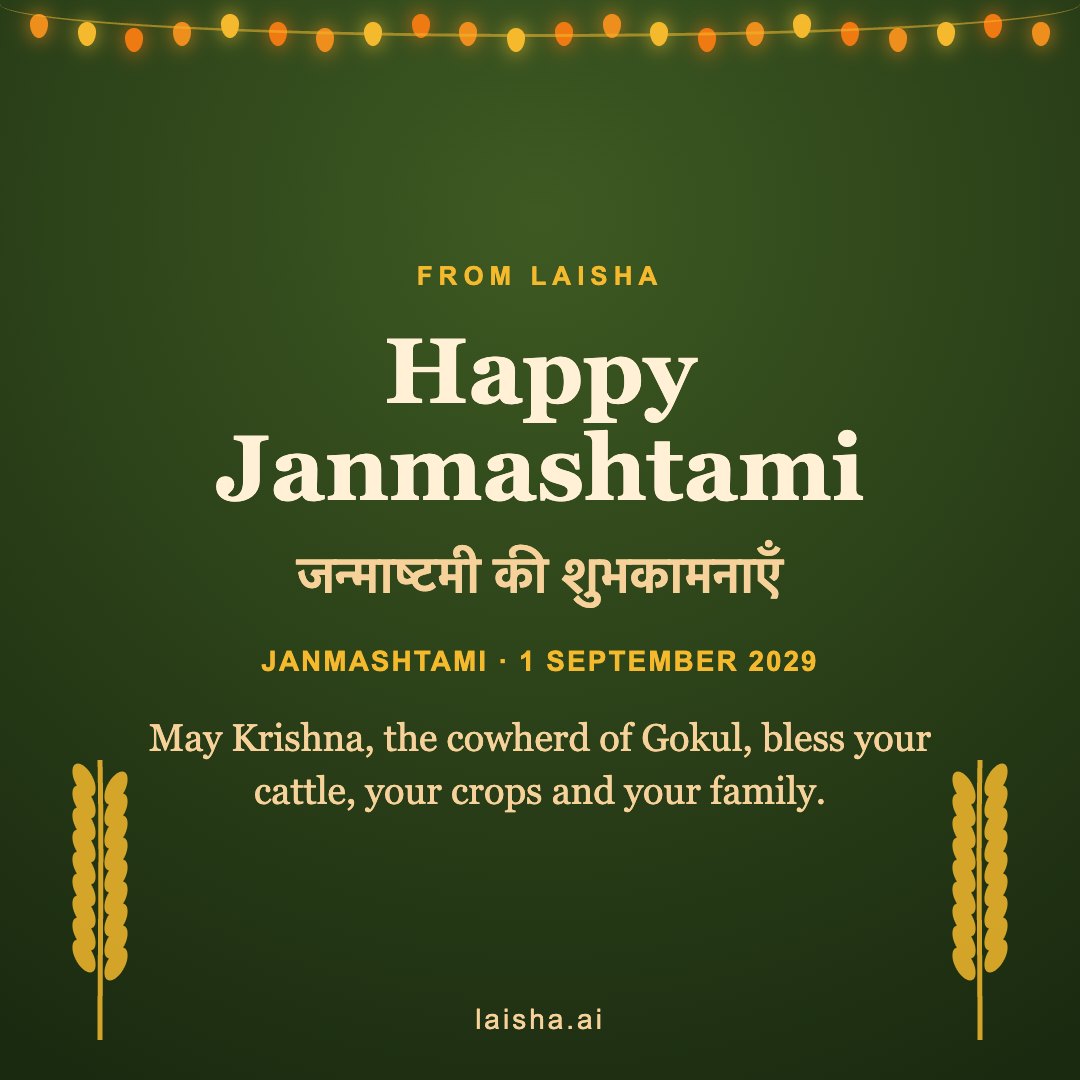
जन्माष्टमी की शुभकामनाएँ
गोकुल के ग्वाले श्रीकृष्ण आपके पशुओं, फ़सलों और परिवार पर कृपा करें।
जन्माष्टमी 2029 के दिन
- श्रीकृष्ण जन्माष्टमी
सितंबर 2029 में खेत पर
जन्माष्टमी मानसून के बीच आती है, जब ख़रीफ़ की फ़सलें तेज़ी से बढ़ रही होती हैं: निराई, जल-निकास और कीटों की निगरानी का समय।
सितंबर में कटाई: धान, मक्का, बाजरा, मूंगफली, सोयाबीन, Cowpea।
शुभकामना भेजें
More festivals
- Makar Sankranti 2029Sunday 14 January 2029
- Eid al-Fitr 2029Thursday 15 February 2029
- Holi 2029Thursday 1 March 2029
- Eid al-Adha 2029Wednesday 25 April 2029
- Navratri and Dussehra 2029Tuesday 16 October 2029
- Diwali 2029Monday 5 November 2029
- Christmas 2029 and New Year 2030Tuesday 25 December 2029
Last updated · How Laisha writes and checks its pages · Report a mistake