Navratri and Dussehra 2030 · Sunday 6 October 2030
Shubh Navratri and Dussehra from Laisha
May the Goddess bless a full kharif harvest and a good rabi sowing.
The days of Navratri and Dussehra 2030
- Navratri begins (Ghatasthapana)
- Maha Navami
- Dussehra · Vijayadashami
Navratri and Dussehra 2030 at a glance
- Main day: Sunday 6 October 2030.
- Year: 2030 CE, Vikram Samvat 2087.
- On the main day in New Delhi: sunrise 06:16, sunset 18:01 IST; Shukla Dashami at sunrise; nakshatra Shravana.
- Compared with 2029: then it was Tuesday 16 October 2029; this year it comes 10 days earlier in the year.
- Next year: Saturday 25 October 2031, 19 days later in the year than this year.
The panchang for each day of Navratri and Dussehra 2030
For New Delhi, in IST. A tithi is the lunar day; it rarely starts at sunrise, so the table gives the tithis that run through each date with their start and end, and the nakshatra at sunrise.
| Day | Sunrise / sunset | Tithi | Nakshatra at sunrise |
|---|---|---|---|
| Navratri begins (Ghatasthapana) Saturday 28 September 2030 | 06:12 / 18:10 | Shukla Pratipada 15:24 (27 Sep)–13:09; Shukla Dwitiya 13:09–10:40 (29 Sep) | Hasta until 13:49 |
| Maha Navami Saturday 5 October 2030 | 06:16 / 18:02 | Shukla Navami 20:31 (4 Oct)–18:53; Shukla Dashami 18:53–17:33 (6 Oct) | Uttara Ashadha until 01:45 (6 Oct) |
| Dussehra · Vijayadashami Sunday 6 October 2030 | 06:16 / 18:01 | Shukla Dashami 18:53 (5 Oct)–17:33; Shukla Ekadashi 17:33–16:31 (7 Oct) | Shravana until 01:13 (7 Oct) |
Sunday 6 October 2030 hour by hour (New Delhi)
Yoga Sukarma until 09:54; karana Gara until 17:33. Moonrise 14:41. Moonset 02:10 (7 Oct).
Daily periods the engine computes: Brahma Muhurat 04:38–05:27; Abhijit Muhurat 11:45–12:32; Rahu Kaal 16:33–18:01; Yamaganda 12:09–13:37; Gulika Kaal 15:05–16:33; Amrit Kaal (Shravana) 15:03–16:37.
| Choghadiya | Day | Night |
|---|---|---|
| 1 | Udveg (bad) 06:16–07:44 | Shubh (good) 18:01–19:33 |
| 2 | Char (neutral) 07:44–09:12 | Amrit (good) 19:33–21:05 |
| 3 | Labh (good) 09:12–10:41 | Char (neutral) 21:05–22:37 |
| 4 | Amrit (good) 10:41–12:09 | Rog (bad) 22:37–00:09 (7 Oct) |
| 5 | Kaal (bad) 12:09–13:37 | Kaal (bad) 00:09 (7 Oct)–01:41 (7 Oct) |
| 6 | Shubh (good) 13:37–15:05 | Labh (good) 01:41 (7 Oct)–03:13 (7 Oct) |
| 7 | Rog (bad) 15:05–16:33 | Udveg (bad) 03:13 (7 Oct)–04:45 (7 Oct) |
| 8 | Udveg (bad) 16:33–18:01 | Shubh (good) 04:45 (7 Oct)–06:17 (7 Oct) |
Computed with the Sunyra astronomical engine. Times shift by a few minutes for other Indian cities. No puja muhurta is given here: our engine computes the tithi, the nakshatra, sunrise and sunset, not the window a family or temple chooses for the puja, so follow your local panchang or priest for that.
Where Navratri and Dussehra 2030 falls in the farming season
Counted from the sowing windows in Laisha's farming calendar for the tropical and monsoon north (South Asia), which gives sowing by month:
- Wheat (cool dry-season wheat): sowing opens in October; 6 October 2030 is 5 days into the window.
- Chickpea: sowing opens in October; 6 October 2030 is 5 days into the window.
- Mustard: sowing opens in October; 6 October 2030 is 5 days into the window.
- Potato (cool-season potato on the plains): sowing opens in October; 6 October 2030 is 5 days into the window.
On the farm in October 2030
Navratri and Dussehra come at the kharif harvest: paddy, cotton, soybean and maize are coming in, and the fields are being readied for rabi.
Harvested in October: Rice (wet-season rice), Maize (wet-season maize), Sorghum, Millet (pearl millet), Groundnut, Cotton.
Farming calendar for October 2030 → · Laisha Lens: this month →
Fasting food from the uplands: samak rice and rajgira
Samak rice and rajgira are two more Navratri staples, and both are hardy crops of poor, rainfed land. In 2030 the fast begins on 28 September, close to the harvest of both crops in many regions.
Samak, sama or vrat ke chawal is not rice. It is barnyard millet, mainly Echinochloa frumentacea in India, one of the small millets. It is grown in Uttarakhand, Madhya Pradesh, Chhattisgarh, Tamil Nadu and other hilly and tribal areas, usually without irrigation or much fertiliser, and matures in as little as about 70 to 90 days, which makes it a reliable crop where the monsoon is short. Its tiny grains are dehulled and cooked like rice, as khichdi or kheer.
Rajgira, meaning royal grain, is grain amaranth, Amaranthus hypochondriacus and related species, a crop domesticated in the Americas and grown in India mainly in the hills and in Gujarat and Rajasthan. Like buckwheat it is a pseudocereal. A single plant carries a large head with thousands of tiny seeds that pop when heated, which is how rajgira laddoos and chikki are made.
The United Nations declared 2023 the International Year of Millets, on India's proposal, and India now promotes millets as Shree Anna. The reasons apply to samak: millets need less water than rice, fit dry uplands, and are rich in fibre and minerals. Their weakness is processing: dehulling small millets is hard work by hand, and small village mills have made a large difference to how much women's labour they require.
For buyers, samak and rajgira keep well as whole grains in a dry, closed container; their flours go stale faster, so grind or buy flour in small amounts.
Sources: ICAR-Indian Institute of Millets Research, Hyderabad · FAO: International Year of Millets 2023
Send a greeting
A card for your family, friends and fellow farmers.
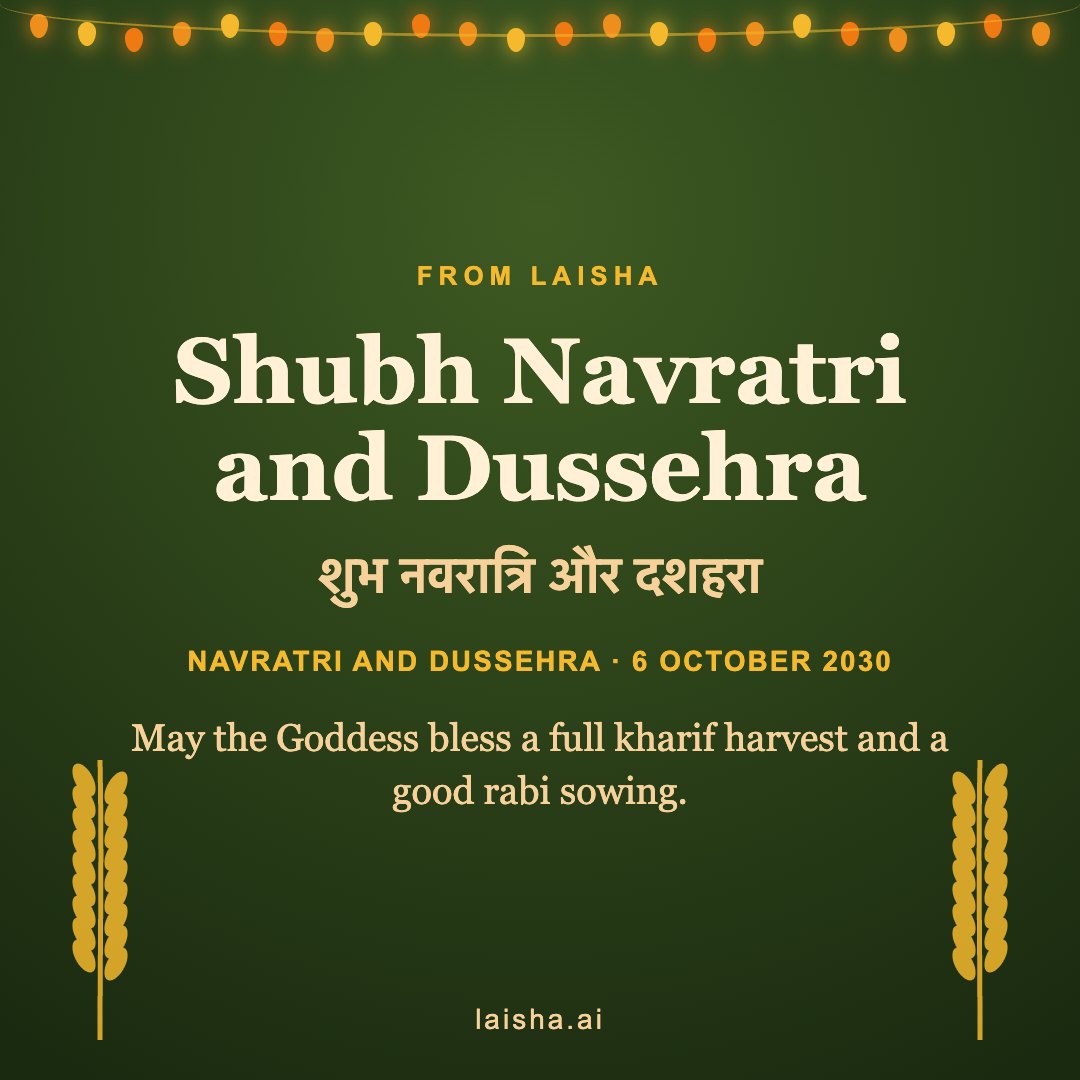
शुभ नवरात्रि और दशहरा
माँ दुर्गा ख़रीफ़ की भरपूर फ़सल और रबी की अच्छी बुआई का आशीर्वाद दें।
नवरात्रि और दशहरा 2030 के दिन
- नवरात्रि आरंभ (घटस्थापना)
- महानवमी
- दशहरा · विजयादशमी
अक्तूबर 2030 में खेत पर
नवरात्रि और दशहरा ख़रीफ़ की कटाई के समय आते हैं: धान, कपास, सोयाबीन और मक्का घर आ रहे होते हैं, और खेत रबी के लिए तैयार किए जा रहे होते हैं।
अक्तूबर में बुआई (दक्षिण एशिया जैसी उष्णकटिबंधीय, मानसूनी जलवायु): गेहूं, चने, सरसों, आलू, टमाटर।
शुभकामना भेजें
More festivals
- Makar Sankranti 2030Monday 14 January 2030
- Eid al-Fitr 2030Tuesday 5 February 2030
- Holi 2030Wednesday 20 March 2030
- Eid al-Adha 2030Sunday 14 April 2030
- Janmashtami 2030Wednesday 21 August 2030
- Diwali 2030Saturday 26 October 2030
- Christmas 2030 and New Year 2031Wednesday 25 December 2030
Last updated · How Laisha writes and checks its pages · Report a mistake