How to Grow Almond
Prunus dulcis · Also called: badam, louz, mandorla, amande, mandel, almendra, badem, amendoa
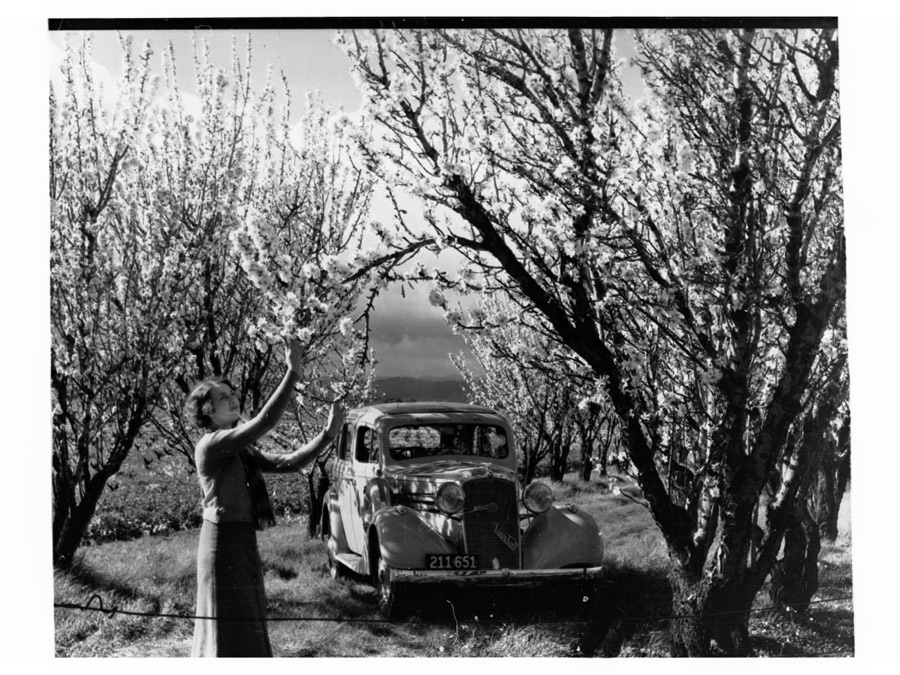
Photo: Captain Frank Hurley, CC0 (Wikimedia Commons)
Almond is a dry-summer tree nut. The kernel is the seed inside the stone of a fruit related to peach, and it is sold shelled or in shell, blanched, ground, pressed for oil or made into almond milk. World production reached approximately 3.9 million tonnes in 2024, with the United States growing about half, roughly 2.0 million tonnes, mostly from irrigated orchards. Around the Mediterranean, the Middle East and Central Asia almond is still often a rainfed crop on poor, stony land with as little as 300 mm of rain, where it ranks among the top ten crops by area in 9 countries. Most varieties cannot pollinate themselves, so orchards mix two or more varieties and bring in honeybee hives at bloom. Bitter almonds contain a cyanide-releasing compound, and sweet almond is a major tree-nut allergen. Any agrochemical must come from a licensed dealer and be used as its label says.
Global Importance
Almond output is led by large irrigated orchards in the United States; FAO's production figures name Spain, Syria, Turkey and Algeria among the other leading growers. In 2009 the world grew almond on about 1.8 million hectares at an average of about 1.3 tonnes of in-shell nut per hectare, a figure that hides very low rainfed yields beside very high irrigated ones.
Market Segments
Almond sells mostly as kernel: natural or blanched, whole, sliced or ground, plus in-shell nuts for snacking, almond milk, and oil. Buyers grade on insect damage, shrivel, kernel colour and broken kernels, and some markets pay more for larger nuts. Hard-shelled Mediterranean types give only 25 to 35 percent kernel by weight; soft-shelled types give about 70.
Growth Habit
Almond is a deciduous Prunus tree with a very low chilling need, so it flowers earlier than almost any other temperate fruit tree, from late winter. Fruit is borne on spurs. Flowering to harvest takes about six months, and next year's flower buds form in late summer, so a dry or stressed tree after harvest loses part of the following crop.
Growing Almond, Stage by Stage
- 1. Pick almond land: mild wet winter, hot dry summer, rare late frost — Almond needs little winter chill and blooms very early, so the biggest site risk is spring frost on open flowers. Choose a frost-free slope or plain with a long, hot, dry summer for kernel fill and hull split, and deep soil that drains. Rainfed almond survives on as little as 300 mm, but full irrigated yields need far more water.
- 2. Choose grafted almond trees as planting material, with a pollinizer variety — Buy grafted trees of named sweet varieties on a rootstock suited to your soil. Most varieties are self-infertile, so plant at least two varieties whose bloom overlaps, often in single alternating rows. Even self-compatible varieties yield more with cross-pollination.
- 3. Plant almond trees while they are dormant — Plant bare-root or potted trees in the dormant season with the graft union above the soil, water them in, and protect the young trunks from sun and animals. Lay out rows so that harvest machinery or tarpaulins can work under every tree.
- 4. Train young almond trees to an open vase — Choose three or four main scaffold branches in the first years to form an open vase that lets light in and can be shaken. Keep young trees fully watered: almond growth is very sensitive to water shortage, and unstressed young trees reach full bearing sooner.
- 5. Water almond through kernel fill and after harvest — Seasonal water use of a fully irrigated almond orchard in a hot, dry climate can reach about 1,250 mm. Where water is short, mild stress during hull split hurts least; stress during early fruit growth, and above all after harvest when next year's flower buds form, costs most. One study saw 40 percent fewer nuts the next year.
- 6. Weed the base and feed almond trees from leaf analysis — Feed almond per tree and adjust with leaf analysis, rising as the young tree grows into its bearing frame. Nitrogen is the main input in irrigated orchards, timed while leaves and nuts are growing; rainfed orchards on poor soil carry far smaller crops and need far less.
- 7. Bring bees to the almond bloom — Almond flowers in late winter, at the same time as leaves start, on bare-looking branches. Each flower must receive pollen from a compatible variety, carried by bees, so hives are moved into the orchard for bloom. Rain, cold and wind during the short bloom cut bee flight and fruit set.
- 8. Prune bearing almond trees lightly — Prune lightly in the dormant season to keep the vase open and renew fruiting spurs; heavy pruning removes spurs and crop. Remove dead and cankered wood and any mummified nuts left on the tree, which shelter navel orangeworm through winter.
- 9. Scout almond for navel orangeworm, hull rot, brown rot and leaf scorch — Navel orangeworm larvae enter nuts once hulls split, so a clean orchard floor and an on-time harvest are the first defence. Brown rot attacks blossom in wet springs; hull rot follows heavy water at hull split. Any spray is chosen with a licensed dealer by IRAC or FRAC group.
- 10. Read almond hull split before shaking — Almond tells you when it is ready. The hull splits along its seam in stages; harvest can start when the lowest nuts inside the canopy have reached full split, with a deep V along the whole seam and the hull opening under thumb pressure, and test trees shake clean.
- 11. Harvest almonds: shake them and dry them on the ground — Shake the trees, or knock the nuts down onto tarpaulins, and leave them to dry on the orchard floor. One California extension article gives about 4 to 7 days of ground drying after full hull split, longer for early-shaken nuts. Sweep up promptly before rain or insects reach them.
- 12. Hull, shell and store almonds dry — Remove the hulls, then sell in shell or crack out the kernels. Do not stockpile or store nuts until hulls and kernels are dry, because damp almonds grow moulds and can carry aflatoxin. Store kernels cool and dry, away from strong smells.
Fertiliser Programme
Almond is fed per tree, starting light on young trees and rising as the canopy fills, and the adult rate is best set by leaf analysis and the size of the crop being carried. An irrigated orchard carrying a heavy crop needs far more nitrogen than a rainfed tree on stony ground.
Common Problems & Troubleshooting
If you see: Blossom wilting suddenly and turning brown during or just after a wet spring, with ash-grey to brown spore masses forming on the dead flowers, and sunken cankers appearing on nearby young twigs.
It likely means: Brown rot, caused by the fungus Monilinia laxa — a real, documented disease of almond and its close stone-fruit relatives, worst in humid conditions during bloom.
Do this: Look over the blossom after every wet spell during bloom; if your extension service confirms brown rot, protect the next bloom with a product chosen by FRAC group.
If you see: New spring leaves puckering, thickening and curling downward and inward, often turning red, yellow or pale, sometimes with affected leaves dropping early.
It likely means: A real leaf-curl disease caused by the fungus Taphrina deformans — a documented pathogen of almond as well as peach and nectarine, though a published source confirms almond-infecting strains and peach-infecting strains genuinely cannot cross-infect the other host.
Do this: Mark affected almond trees in spring, and ask your extension service whether a dormant-season treatment is advised where you grow.
If you see: Leaf edges scorching to a yellowish-brown on an older tree through summer, with genuinely stunted new growth, despite no obvious water shortage.
It likely means: Almond leaf scorch, caused by the bacterium Xylella fastidiosa — a real, globally significant pathogen with no known cure, spread by real, xylem-feeding insects such as sharpshooters and spittlebugs.
Do this: Report a suspected almond leaf scorch case to your plant health authority at once, since Xylella is a regulated pest in many countries.
If you see: Small entry holes, webbing and larvae found inside hulls and shells at or near harvest, often alongside old, unharvested fruit left hanging from a previous season.
It likely means: Navel orangeworm, Amyelois transitella — a real, documented commercial pest of almond, walnut, fig and pistachio, active from spring through autumn.
Do this: Harvest promptly once hulls have genuinely split across the orchard, since fruit left hanging longer is more open to this pest.
If you see: Sunken, discoloured patches of bark oozing gum, and dead twigs or whole branches, appearing worst after a real, hard frost or cold snap.
It likely means: Bacterial canker, caused by Pseudomonas syringae — a real, documented bacterium of the wider Prunus family, with a published source confirming freezing temperatures genuinely worsen infection severity in close stone-fruit relatives such as cherry, apricot and peach.
Do this: Ask a plant-pathology service to confirm bacterial canker before acting, since gumming on almond also follows borers, sunburn and frost.
If you see: Kernels that were left damp, insect-damaged or slow to dry showing a dusty, discoloured mould growth once cracked open, sometimes with an off smell.
It likely means: A real, dangerous mould, most often Aspergillus flavus or Aspergillus parasiticus, capable of producing aflatoxin, a real, documented carcinogenic toxin — a published source confirms the European Union requires aflatoxin testing on all almond shipments specifically because of this real risk.
Do this: Dry hulled nuts thoroughly and promptly after harvest, since damp storage is this mould's own single biggest real invitation.
Real Farm Economics
An almond orchard costs money for several years before its first useful crop, then earns for decades. On top of trees, water and harvest gear, a commercial grower usually pays to rent hives at bloom. Water is the other big lever: rainfed orchards cost little and yield little, while fully irrigated ones yield much more.
Yield & Market Value
Almond yields range from very low on rainfed Mediterranean slopes to far higher in fully irrigated orchards; FAO put the 2009 world average at about 1.3 tonnes of in-shell nut per hectare. Almond is not in Laisha's live price service yet, so ask local buyers how they grade and pay for kernel before selling.
Remember It This Way
Eight lines for an almond orchard, from frost-free site to dry kernel in the store.
- Low chill, early bloom: plant where spring frost is rare.
- Two varieties that bloom together, in alternating rows.
- Hives in at bloom. No bees, no nuts.
- Never let young trees go thirsty.
- Water after harvest too: next year's buds are forming.
- Shake when the lowest hulls inside the tree have split.
- Let them dry on the ground, then sweep before rain.
- Never store damp almonds. Mould brings aflatoxin.
Test Yourself: Identification
What crop is this, small trees covered in pale pink-white blossom, standing bare of leaves in straight rows across a field?
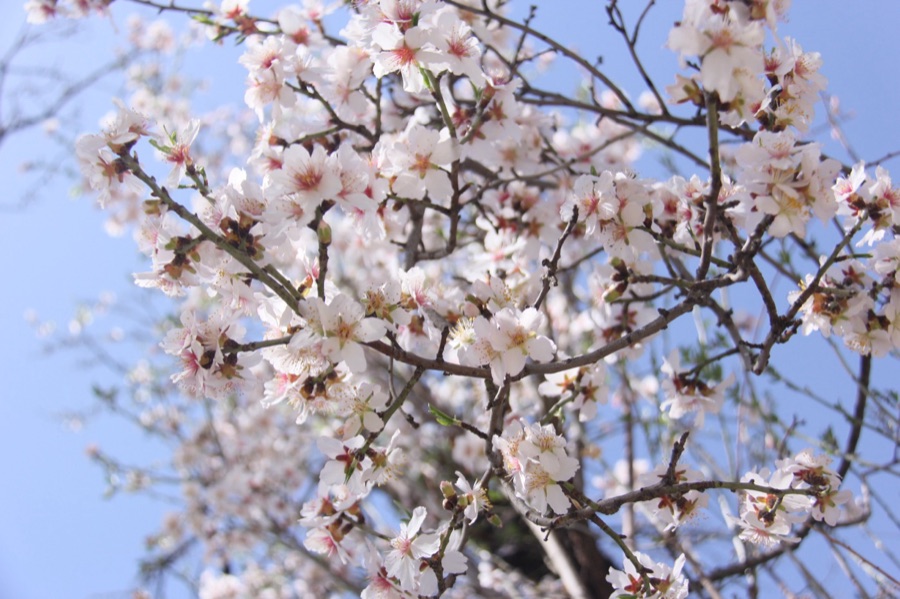
What is this pale pink-white, five-petaled flower opening directly on a bare branch with no leaves nearby?
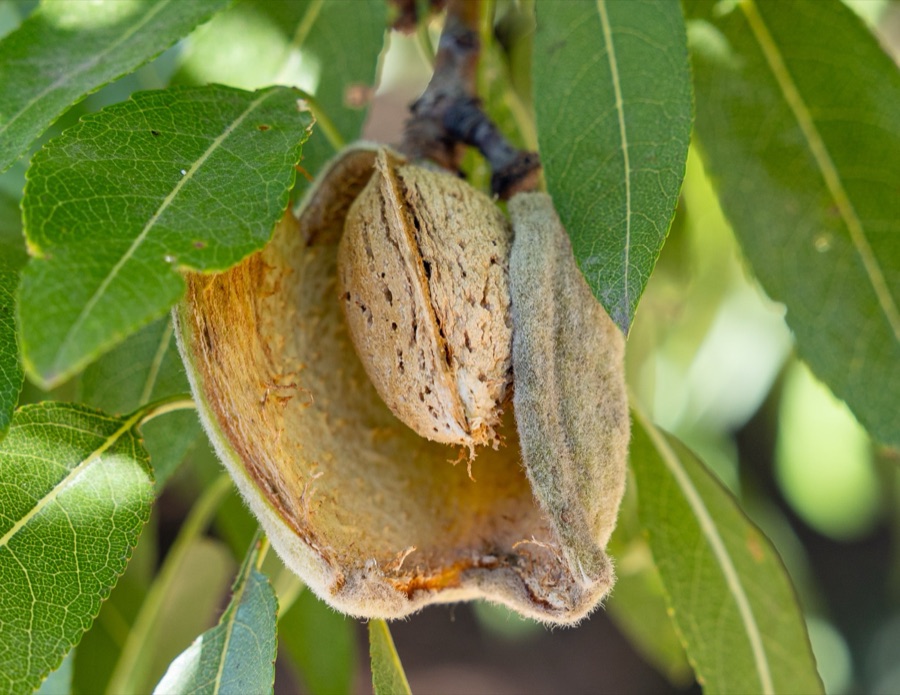
What is this grey-green, velvety fruit splitting open along a seam while still hanging from a short stem on the tree?
Honest Limits of This Guide
- World and country production figures for 2024 come from a published article citing FAOSTAT data, not a fresh FAOSTAT download; the 1.8 million hectare and 1.3 tonne figures are FAO's own for 2009.
- The water figures, including the 1,250 mm seasonal need and the 40 percent loss after post-harvest drought, come from Californian and Spanish research summarised by FAO. Orchards in cooler or wetter places use less.
- Harvest timing and ground-drying days come from one Californian extension article for local varieties; other varieties and climates differ.
- No single per-tree fertiliser schedule by age is given, because recommendations depend on leaf analysis and crop load.
- No pesticide product or active ingredient is named. Control is described by IRAC and FRAC group only, and registrations differ by country.
- Bloom and harvest months are not given as a calendar because they swap between the northern and southern hemispheres.

The rest of this Almond guide is inside Laisha
Every stage, the full fertiliser programme, the economics and the pest diagnosis for Almond live in the app — alongside photo-based diagnosis, live market prices, and an agronomist you can actually ask.
Open Laisha — ten days freeTen days free, no card. After that 10 US dollars a month, one price worldwide.
1 more sections of this guide continue inside.
Related Laisha Tools
- Global Market Price Outlook — Check today's price and trend
- Crop Calendar — Build a season-long sowing plan
- Pest & Disease Intelligence — Risk reasoning and a global pest & disease library
- Crop Health — Photo-based first read on a field problem
- Soil Health — Track soil test results across seasons
Sources
- GBIF Backbone Taxonomy species-match record for Prunus dulcis (Mill.) D.A.Webb (usage key 3022502, a synonym of accepted usage key 3020980, Prunus amygdalus Batsch) — Global Biodiversity Information Facility (GBIF), Copenhagen (source)
- World Checklist of Vascular Plants (WCVP) search results for Prunus dulcis, queried live through GBIF's own hosted copy of the checklist — Royal Botanic Gardens, Kew, hosted via GBIF (dataset f382f0ce-323a-4091-bb9f-add557f3a9a2) (source)
- EPPO Global Database taxon record for Prunus dulcis (EPPO code PRNDU) — European and Mediterranean Plant Protection Organization (EPPO) (source)
- Almond — Wikipedia, citing FAOSTAT production data (source)
- Bitter almond — Wikipedia (source)
- Amygdalin — Wikipedia (source)
- Tree nut allergy — Wikipedia (source)
- Peach (Prunus persica) — Wikipedia (source)
- Amyelois transitella (navel orangeworm) — Wikipedia (source)
- Monilinia laxa — Wikipedia (source)
- Xylella fastidiosa — Wikipedia (source)
- Taphrina deformans — Wikipedia (source)
- Pseudomonas syringae — Wikipedia (source)
- Laisha's own curated global crop build-priority research, built on FAOSTAT's own 'Almonds, in shell' item category — Laisha (internal curated research, sourced from FAOSTAT QCL 2025) (source)
- Laisha's own curated agrochemical mode-of-action and hazard-band reference — Laisha (internal curated research) (source)
- Almond (Goldhamer D.A. and Girona J.), in Crop Yield Response to Water, FAO Irrigation and Drainage Paper 66 (Steduto P. et al., eds.), 2012 — Food and Agriculture Organization of the United Nations (FAO), Rome (source)
- When do you shake almonds? (Reyes C., Milliron L. and Niederholzer F.) — University of California Cooperative Extension, Sacramento Valley Orchards (source)
Last updated · How Laisha writes and checks its pages · Report a mistake
Go further with Laisha Smarter
US$10 a month · one price worldwide · cancel any time
- Your own crop calendar for this crop, stage by stage
- Pest and disease alerts with IRAC/FRAC-group spray plans
- Ask Laisha about your field — up to 1,000 questions a month
| Free | Smarter | |
|---|---|---|
| Grow guides, pest pages, articles | Read all | Read all |
| Ask Laisha | 5 a day | Up to 1,000 a month |
| Exam practice | The sample on each page | Every question, timed papers |
| Crop calendar and pest alerts | — | For your own fields |
| Calculators and tools | — | All |
| Uploads and reports | — | 100 a month, real files |