How to Grow Caraway
Carum carvi · Also called: Meridian fennel, Persian cumin, Kümmel, Kminek, Karvi, Vilayati jeera, Kervel
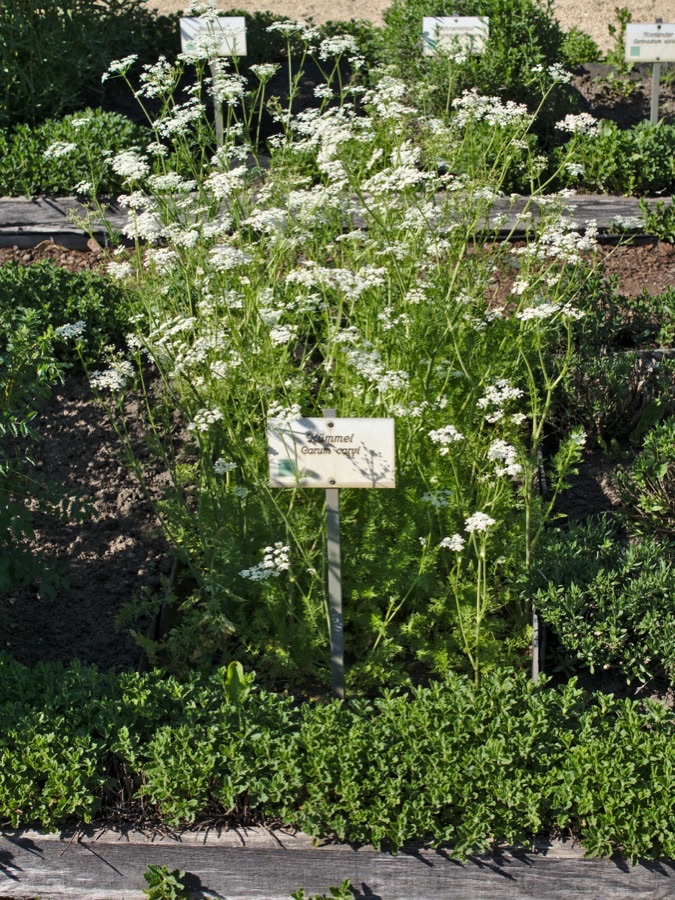
Photo: Alexander Klink, CC BY 4.0 (Wikimedia Commons)
Caraway is a two-year crop that most growers treat as a one-year crop and are then disappointed by. It spends its first year making nothing but a rosette of leaves and a taproot, needs a cold winter to trigger it, and only in the second summer sends up a stem, flowers and sets the seed you are growing it for. Understanding that is the whole difference between a crop and a wasted season. The seed is a cool-country spice with a steady trade: the Netherlands, Finland, Poland, Germany, Canada and Egypt all grow it commercially, and it flavours rye bread, cheese, cabbage dishes and spirits across northern and eastern Europe. It is hardy, it asks little, and it leaves the ground in good condition. The root of the first-year plant is edible too, though almost nobody sells it.
Growing Caraway, Stage by Stage
- 1. Get the land ready — Clean ground matters more here than rich ground.
- 2. Sow the seed, and consider a nurse crop — Sown straight into the ground, and often under something else.
- 3. Weed and water through the first year — A whole year of doing very little, and one thing that matters enormously.
- 4. The second year, when the stem and the seed come — Everything you waited for happens in about ten weeks.
- 5. Watch for trouble — One caterpillar that webs the heads, and rot in wet ground.
- 6. Harvest before the heads shatter — Two days decide fourteen months of work.
- 7. Dry, clean, store and sell the seed — A keeping crop, which means you can wait for a price.
Common Problems & Troubleshooting
If you see: A healthy bed of caraway that grew all season and never flowered or set any seed.
It likely means: Nothing is wrong. Ordinary caraway is a two-year plant: a rosette and a taproot in the first year, and stems, flowers and seed only in the second.
Do this: Leave the crop standing and weed it again in the second spring.
If you see: A first-year bed where the caraway has disappeared under grass and broadleaf weeds.
It likely means: The first-year rosette is small, flat and slow, and it cannot compete with anything. This is how most caraway crops are lost.
Do this: Start with the cleanest ground you have, since weeding is far harder than not needing to weed.
If you see: Seed all over the ground under the plants, and heads that are nearly empty when you cut them.
It likely means: The crop was left too long. Ripe caraway heads shatter, and they do it within a day or two of being ready.
Do this: Watch the crop daily from the moment the flowers fade.
If you see: Flower heads drawn together with silk webbing, with a caterpillar and its droppings inside.
It likely means: The caterpillar that specialises in this family's flower heads. It eats exactly the part you are growing the crop for.
Do this: Cut out and burn webbed heads as soon as you see them, where the planting is small enough.
If you see: Large gaps in the rows in the second spring where healthy rosettes stood in autumn.
It likely means: Usually water standing over winter rotting the taproot, sometimes soft growth from heavy feeding, sometimes a winter too mild to trigger flowering in the survivors.
Do this: Choose well-drained ground, since this is far more often a drainage problem than a cold one.
If you see: A cleaned lot refused by a buyer, or paid for at a much lower grade than expected.
It likely means: Usually moisture, dust and chaff, or foreign seed. Caraway is commonly adulterated, so buyers check it carefully.
Do this: Dry the cleaned seed in shade until it is hard and rattles, and never store it even slightly damp.
Yield & Market Value
Growing the crop is only part of the job. The last part is knowing what a normal harvest looks like where you are, and knowing what your caraway is worth before you agree a price with anybody.
Remember It This Way
If you forget every other page of this guide, keep these lines. They are the whole crop, in order, short enough to carry in your head.
- Two years. Nothing to harvest in the first one.
- Start with the cleanest ground you have.
- Sow it where it will grow. It hates being moved.
- The first year is a flat rosette. That is correct.
- Weed it by hand. A hoe cuts the taproot.
- It needs a cold winter to flower at all.
- Do not feed it. Soft plants die over winter.
- In the second summer, watch it every day.
- Cut when the seed has browned and the head still holds.
- Dry it in shade. Sun takes the smell and the price.
Test Yourself: Identification
What does the standing crop look like in its second year?
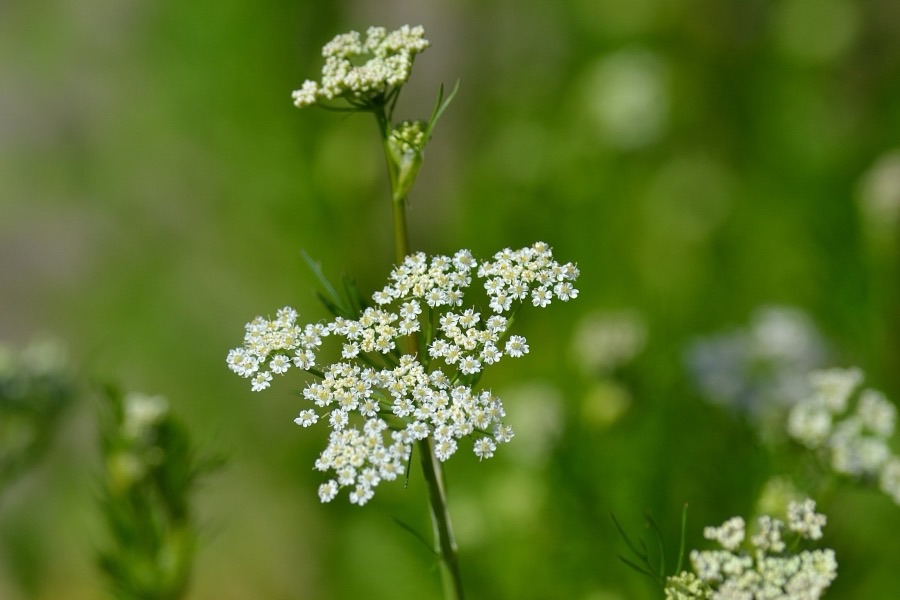
What do the flowers look like?
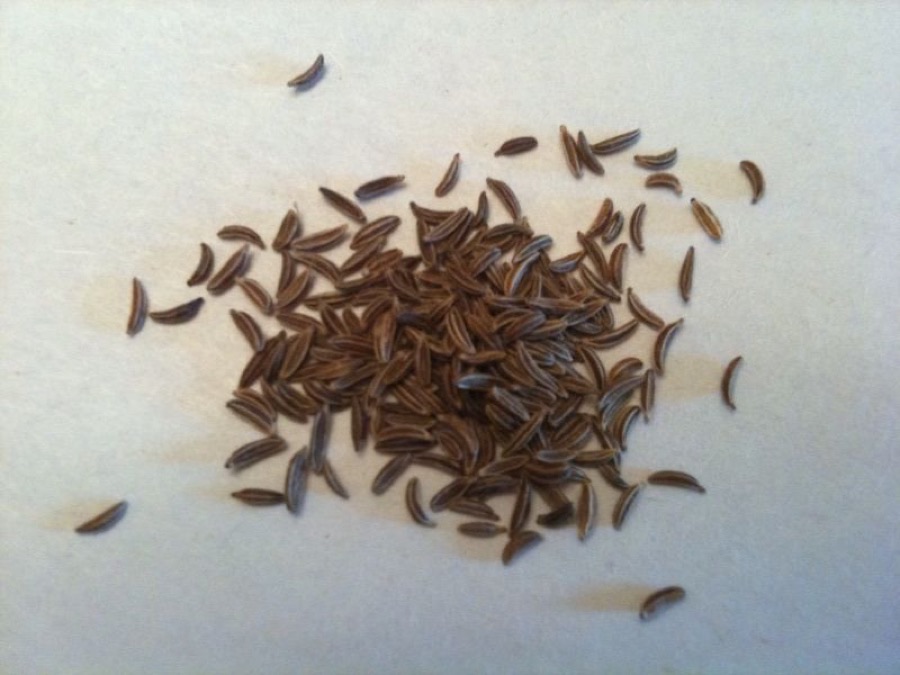
What does the seed look like?
Honest Limits of This Guide
- Timings here are given by year and by the state of the plant rather than in named months, because caraway is grown in both hemispheres. Count from your own sowing and your own winter.
- This guide describes the ordinary two-year caraway. Annual types exist and crop in a single season; they are mentioned because the choice matters, but they yield less and are not covered in detail here.
- Caraway needs a real winter. It is included because it is a good crop where that exists, not because it can be grown everywhere.
- The last picture is a botanical illustration, not a photograph. It is used because it shows the taproot, the divided leaf, the stem and the split seed together, and no usable photograph does that.
- There is no photograph here of a first-year rosette, of the crop being cut, or of seed being threshed and winnowed, because usable pictures of that work are not available under a licence this library can use.
- No varieties are named here. Types differ in whether they are annual or two-year and in how readily they shatter, and which suits a district is a question for a local seed dealer.
- No chemical treatments are named here. The seed is eaten, insects must work the flowers for there to be a crop, and what is permitted differs by country and by buyer.
Sources
- GBIF Backbone Taxonomy species-match record for Carum carvi L. — Global Biodiversity Information Facility (GBIF), Copenhagen (source)
- EPPO Global Database — Carum carvi (EPPO code CRYCA) — European and Mediterranean Plant Protection Organization (EPPO), Paris (source)
- Carum carvi — CABI Compendium datasheet — CABI, Wallingford (source)
- FAO guidance on growing culinary and aromatic herbs and spice seeds — Food and Agriculture Organization of the United Nations (FAO), Rome (source)
- FAO guidance on post-harvest handling of spice seeds — Food and Agriculture Organization of the United Nations (FAO), Rome (source)
Last updated · How Laisha writes and checks its pages · Report a mistake
Go further with Laisha Smarter
US$10 a month · one price worldwide · cancel any time
- Your own crop calendar for this crop, stage by stage
- Pest and disease alerts with IRAC/FRAC-group spray plans
- Ask Laisha about your field — up to 1,000 questions a month
| Free | Smarter | |
|---|---|---|
| Grow guides, pest pages, articles | Read all | Read all |
| Ask Laisha | 5 a day | Up to 1,000 a month |
| Exam practice | The sample on each page | Every question, timed papers |
| Crop calendar and pest alerts | — | For your own fields |
| Calculators and tools | — | All |
| Uploads and reports | — | 100 a month, real files |