How to Grow Cashew
Anacardium occidentale · Also called: cashew nut, caju, cajueiro, acajou, marañón, anacardo, kaju, kasoy
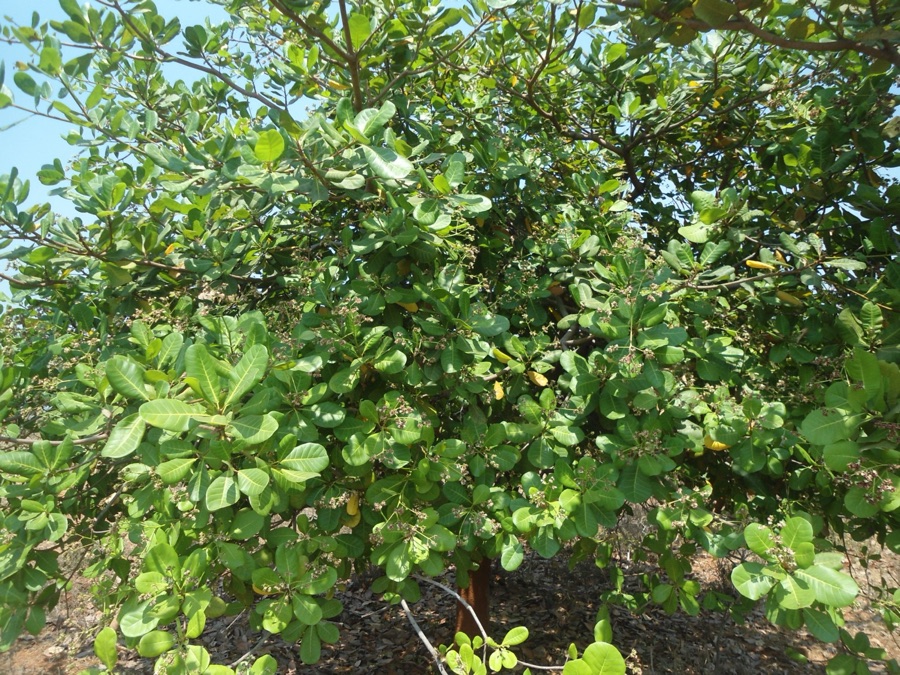
Photo: Adityamadhav83, CC BY-SA 4.0 (Wikimedia Commons)
Cashew farming turns poor, sandy or lateritic land with a long dry season into an export crop. The tree is grown across West Africa, East Africa, South and South-East Asia and north-east Brazil. World production reached approximately 4.2 million tonnes of raw nut in 2024, with Ivory Coast and India together growing about 41 percent of it, and in Guinea-Bissau cashew is the largest crop of all. A cashew farm sells raw in-shell nuts, dried on the farm, to a processor; the shell holds a caustic liquid, so shelling is factory work. The kernel is a known tree-nut allergen. In India, grafted trees start bearing after the third year and reach full crop by about the tenth. Any agrochemical used on the farm must come from a licensed dealer and be used exactly as its label says.
Global Importance
Most of the world's raw cashew now comes from West Africa, led by Ivory Coast, with India, Tanzania, Vietnam and Ghana the other big growers. A farm's raw-nut price follows what processors will pay for kernel.
Market Segments
A cashew farm sells three things from one fruit: the raw in-shell nut to processors, which is almost all the income; the juicy cashew apple, sold fresh or for juice where a market exists; and, through the processor, shell liquid for industry. Kernels are graded by count, with whole white W-210 to W-240 kernels the grades most wanted.
Growth Habit
Cashew is an evergreen tree up to about 12 m tall, wide rather than tall on poor coastal sands. It is grown from grafts because seedlings vary. Trees flower in their third to fifth year. The Brazilian early dwarf clone CCP 76 measured about 3 to 5 m tall in its fourth or fifth year. Each flower can give a kidney-shaped nut, the true fruit, under a swollen stalk, the cashew apple.
Growing Cashew, Stage by Stage
- 1. Pick cashew land: dry season, deep free-draining soil, no frost — Cashew wants heat, no frost, 500 to 3,500 mm of rain, and above all a dry spell of several months when it flowers and the nuts mature. Plant on deep, free-draining sandy, loamy or lateritic soil; avoid heavy clay, waterlogged, saline or alkaline land. Below about 1,000 mm of rain the soil must be deep, with no hard layer.
- 2. Buy grafted cashew plants of a proven clone — Cashew is cross-pollinated, so a tree raised from seed rarely matches its mother. Buy softwood grafts or other clonal plants of a variety released for your region from a registered nursery. Early dwarf clones bear sooner on smaller trees; common tall varieties may suit harsher sites better.
- 3. Plant cashew grafts at the start of the rains — Plant at the onset of the rainy season into the filled pit, with the graft joint above the soil. Stake each plant against wind, mulch the basin, and give water in the first dry season. Remove any shoots from the rootstock below the graft as soon as they appear.
- 4. Train the young cashew tree and grow crops between the rows — For the first years, shape a single trunk about 1 m high with a few well-spaced main branches, and remove the first flowers on very small trees so they grow first. Grow short crops such as groundnut, cowpea or other pulses, cassava, sorghum or millets between the rows until the canopy closes.
- 5. Water cashew while young, then rely on rain and stored soil water — Most cashew is rainfed. Young plants need water through their first dry seasons. A mature tree survives long dry spells on its deep roots, but extra water in the dry season from new leaf flush to nut maturity raises yield where irrigation exists. Rain during flowering causes disease and flower drop.
- 6. Weed the base and feed cashew trees by age — Feed each tree by its age, base the dose on a soil test, and spread fertiliser in a ring under the edge of the canopy after weeding. One Indian schedule starts at 70 g nitrogen per tree in year one and rises to 500 g nitrogen, 200 g phosphate and 300 g potash a year from year five, split into two doses during the rains.
- 7. Cashew flowering, pollination and the apple-and-nut fruit — Cashew flowers in the dry season on panicles at the shoot tips that carry many male flowers and fewer bisexual ones. Bees, flies, ants and wind pollinate them. Only bisexual flowers set nuts. As the nut matures, the stalk above it swells within a few days into the apple.
- 8. Prune the bearing cashew canopy after harvest — Prune each year after harvest and before the new leaf flush: take out dead, diseased, crossing and downward-growing branches and water shoots. In close plantings, thin trees in stages before canopies lock. Old, poor trees can be cut back to a stump and top-worked with grafts of a better variety.
- 9. Scout cashew for tea mosquito bug, stem borer, anthracnose and dieback — The worst damage comes at new leaf flush, flowering and fruit set. Tea mosquito bug in Asia and coreid bugs in Africa scorch shoots and panicles; stem and root borers kill whole trees; anthracnose, powdery mildew and dieback hit flowers and young nuts in humid spells. Any spray is chosen with a licensed dealer by IRAC or FRAC group.
- 10. Collect fallen cashew nuts every few days — Harvest starts after the third year and runs for several months of each dry season. The standard method is to let the ripe apple and nut fall and pick them up from the ground every few days, or weekly at the least. Apples wanted for juice or table use are picked from the tree when fully coloured.
- 11. Twist off the nut and sun-dry raw cashew to below 9 percent moisture — Twist the nut off the apple on the day of collection. Sun-dry the raw nuts in a thin layer on a clean floor or tarpaulin for two to three days, turning them, until moisture falls from about 25 percent to below 9 percent and they rattle. Bag dry nuts in clean sacks and store them off the floor.
- 12. Store and sell raw cashew nuts by quality — Buyers judge raw cashew on moisture, nut count per kilogram and kernel outturn, the share of good kernel inside. The shell is about seven tenths of the nut's weight, so a farm sells mostly shell. Shelling needs heat to destroy the caustic shell liquid and is done by processors, who grade kernels as W-210, W-240 and so on.
Fertiliser Programme
Cashew is fed per tree and by age. One published Indian schedule rises from 70 g nitrogen per tree in year one to 500 g nitrogen, 200 g phosphate and 300 g potash from year five, with manure; other national schedules differ, so a soil test and local advice decide your figure.
Common Problems & Troubleshooting
If you see: Black, dry streaks on tender cashew shoots and scorched, drying flower panicles after a leaf flush or at flowering.
It likely means: Tea mosquito bug (Helopeltis), the main sap-sucking pest of cashew in India and South-East Asia, whose feeding kills young shoots and blossoms.
Do this: Check new flushes, panicles and fruit set every week; one Indian guide times protection at flushing, flowering and fruit set, with any spray chosen by IRAC group from a licensed dealer.
If you see: Dark, sunken, resin-oozing spots on cashew shoots, panicles, young nuts and apples in wet or humid weather.
It likely means: Anthracnose, caused on cashew by Colletotrichum fungi, worst when rain falls during flowering and nut set.
Do this: Prune dead and infected twigs after harvest so the canopy dries fast, and if a fungicide is needed choose it by FRAC group for the flush period.
If you see: A white or grey powder on cashew flower panicles, tender leaves and tiny nuts, with flowers drying and young nuts dropping.
It likely means: Powdery mildew of cashew (Erysiphe quercicola, also called Oidium anacardii), a disease of the flowering period that can strip a tree of its young nuts.
Do this: Inspect panicles from the first flowers onward, ask which local clones tolerate it, and rotate FRAC groups if you spray.
If you see: Cashew branches drying from the tip backward, pinkish crust or gum oozing on the bark, and leaves wilting on single limbs.
It likely means: Dieback or pink disease and gummosis, fungal problems that enter through wounds and stressed wood.
Do this: Cut out the dying branch well into healthy wood, burn it, and protect large cuts as your extension service advises.
If you see: Small, slender insects with a real, visible reddish band across the body, clustered on the undersides of leaves and young shoots, alongside a silvery scarring on affected leaf surfaces.
It likely means: Red-banded thrips (Selenothrips rubrocinctus), a cashew leaf pest that silvers and bronzes the foliage.
Do this: Look under young leaves during each flush and act only when damage spreads, since natural enemies often hold this pest down.
If you see: Shrivelled, distorted young shoots and developing fruit, with a small, elongated, dark bug visible feeding directly on the affected tender growth.
It likely means: Coreid bugs such as Pseudotheraptus wayi, the coconut bug, which attacks cashew shoots and young nuts in East Africa.
Do this: Conserve ants and other natural enemies by avoiding routine broad sprays, and check shoots and young nuts weekly.
If you see: Holes and gum at the base of the cashew trunk, sawdust-like frass pushed out of the bark, yellowing leaves and a tree dying branch by branch.
It likely means: Stem and root borers, beetle grubs that tunnel in the trunk and roots, or ambrosia beetles such as Euplatypus parallelus.
Do this: Inspect the trunk base twice a year, cut out grubs from early holes, and remove and burn dead or badly bored trees.
Real Farm Economics
Cashew earns nothing for about three years, then rises slowly: one Indian estimate gives about 2 kg of raw nut per tree at three to five years, 4 kg at six to ten, and 5 to 10 kg after that. Intercrops pay the early years. Grafted or dwarf clones change the numbers most: a Brazilian dwarf clone gave about 1.5 tonnes per hectare rainfed in year five.
Yield & Market Value
A typical cashew farm yields well under a tonne of dried raw nut per hectare; FAOSTAT-based country averages run from about 0.34 t in Tanzania to 1.72 t in Gambia. Cashew is not yet in Laisha's live price service, so ask local processors and cooperatives for the raw-nut price and how they measure kernel outturn.
Remember It This Way
Eight lines that walk a cashew farm from the site to the sack of dried nuts.
- Long dry season, no frost, deep sand or laterite that drains.
- Plant grafts of a known clone, not seed from the market.
- Seven to eight metres between common trees.
- Rain when it grows, dry when it flowers and ripens.
- Watch every flush for tea mosquito bug.
- Let ripe fruit fall, collect it every few days.
- Twist off the nut, sun it two or three days until it rattles.
- Never crack a raw shell. The processor's heat makes it safe.
Test Yourself: Identification
What crop is this, a broad, spreading evergreen tree with leathery leaves growing in a planted field?
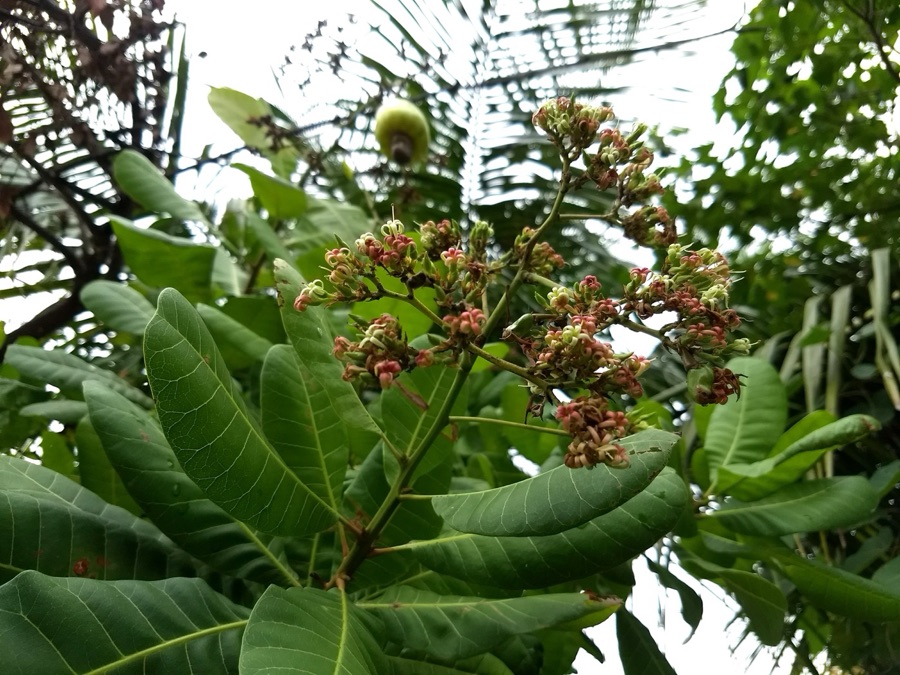
What is this small, branched cluster of pale green and reddish flowers at a shoot tip?
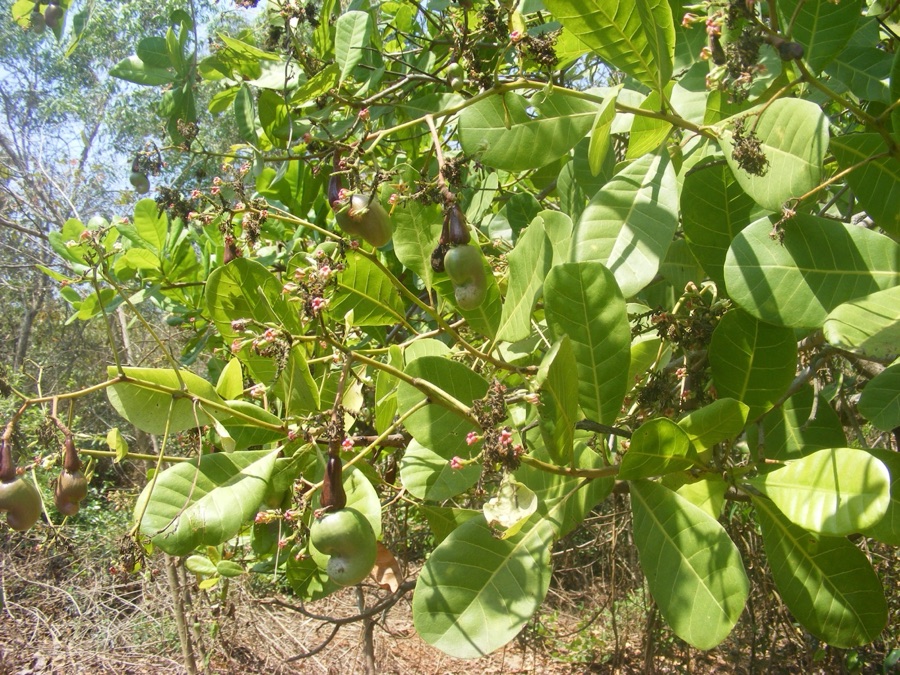
What is this swollen, colourful fruit with a hard, kidney-shaped nut hanging below it?
Honest Limits of This Guide
- World and country production figures come from a published article citing FAOSTAT data for 2024, not a fresh FAOSTAT download.
- Spacing, pit size and the fertiliser schedule come mainly from Indian sources (Tamil Nadu Agricultural University and an FAO 1998 review) and one Brazilian Embrapa leaflet. West African and East African recommendations may differ; check them with your national cashew research body.
- Two published adult fertiliser doses differ by about half, so they are given as examples, not a prescription.
- No pesticide product or active ingredient is named. Control is described by IRAC and FRAC mode-of-action group only; registrations differ by country, so follow your licensed dealer and the label.
- Harvest months are not given because cashew fruits in the local dry season, which falls in different months north and south of the equator.
- EPPO's cashew host list did not show powdery mildew when checked, though the fungus's own EPPO page calls it powdery mildew of cashew.

The rest of this Cashew guide is inside Laisha
Every stage, the full fertiliser programme, the economics and the pest diagnosis for Cashew live in the app — alongside photo-based diagnosis, live market prices, and an agronomist you can actually ask.
Open Laisha — ten days freeTen days free, no card. After that 10 US dollars a month, one price worldwide.
1 more sections of this guide continue inside.
Related Laisha Tools
- Global Market Price Outlook — Check today's price and trend
- Crop Calendar — Build a season-long sowing plan
- Pest & Disease Intelligence — Risk reasoning and a global pest & disease library
- Crop Health — Photo-based first read on a field problem
- Soil Health — Track soil test results across seasons
Sources
- GBIF Backbone Taxonomy species-match record for Anacardium occidentale L. (usage key 5421368) — Global Biodiversity Information Facility (GBIF), Copenhagen (source)
- World Checklist of Vascular Plants (WCVP) search results for Anacardium occidentale, queried live through GBIF's own hosted copy of the checklist — Royal Botanic Gardens, Kew, hosted via GBIF (dataset f382f0ce-323a-4091-bb9f-add557f3a9a2) (source)
- EPPO Global Database record for Anacardium occidentale (EPPO code ANAOC) — European and Mediterranean Plant Protection Organization (EPPO) (source)
- EPPO Global Database pest and disease host-plant cross-reference for Anacardium occidentale — European and Mediterranean Plant Protection Organization (EPPO) (source)
- EPPO Global Database record for Helopeltis antonii (EPPO code HELOAN) — European and Mediterranean Plant Protection Organization (EPPO) (source)
- EPPO Global Database record for Erysiphe quercicola (EPPO code OIDIAN), synonym Oidium anacardii — European and Mediterranean Plant Protection Organization (EPPO) (source)
- EPPO Global Database record for Colletotrichum fructicola (EPPO code COLLFC) — European and Mediterranean Plant Protection Organization (EPPO) (source)
- EPPO Global Database record for Lasiodiplodia theobromae (EPPO code PHYORH) — European and Mediterranean Plant Protection Organization (EPPO) (source)
- EPPO Global Database record for Selenothrips rubrocinctus (EPPO code SLENRU) — European and Mediterranean Plant Protection Organization (EPPO) (source)
- EPPO Global Database record for Pseudotheraptus wayi (EPPO code PSDTWA) — European and Mediterranean Plant Protection Organization (EPPO) (source)
- EPPO Global Database record for Euplatypus parallelus (EPPO code PLTPPA) — European and Mediterranean Plant Protection Organization (EPPO) (source)
- Cashew — Wikipedia, citing FAOSTAT production data (source)
- Accessory fruit — Wikipedia (source)
- Anacardic acid — Wikipedia (source)
- Colletotrichum gloeosporioides — Wikipedia (source)
- Anacardium occidentale (Cashew), in Dr. Duke's Phytochemical and Ethnobotanical Databases — USDA, hosted by Purdue University Center for New Crops and Plants Products (source)
- Laisha's own curated global crop build-priority research, built on FAOSTAT's own cashew nut item category — Laisha (internal curated research, sourced from FAOSTAT QCL 2025) (source)
- Laisha's own curated agrochemical mode-of-action and hazard-band reference — Laisha (internal curated research) (source)
- Integrated Production Practices of Cashew in Asia (Papademetriou M.K. and Herath E.M., eds.), chapter on India by E.V.V. Bhaskara Rao — FAO Regional Office for Asia and the Pacific, Bangkok (source)
- Cashewnut (Anacardium occidentale L.) — horticulture crop production guide, TNAU Agritech Portal — Tamil Nadu Agricultural University (TNAU), Coimbatore (source)
- Cajueiro-anão-precoce para a região Meio-Norte do Brasil: clone CCP 76 (Ribeiro J.L. et al.) — Embrapa Meio-Norte, Teresina, Brazil (source)
- Anacardium occidentale — Agroforestree Database 4.0 species profile (Orwa C. et al.) — World Agroforestry (ICRAF), Nairobi (source)
Last updated · How Laisha writes and checks its pages · Report a mistake
Go further with Laisha Smarter
US$10 a month · one price worldwide · cancel any time
- Your own crop calendar for this crop, stage by stage
- Pest and disease alerts with IRAC/FRAC-group spray plans
- Ask Laisha about your field — up to 1,000 questions a month
| Free | Smarter | |
|---|---|---|
| Grow guides, pest pages, articles | Read all | Read all |
| Ask Laisha | 5 a day | Up to 1,000 a month |
| Exam practice | The sample on each page | Every question, timed papers |
| Crop calendar and pest alerts | — | For your own fields |
| Calculators and tools | — | All |
| Uploads and reports | — | 100 a month, real files |