How to Grow Cucumber
Cucumis sativus · Also called: kheera, khira, vellarikka, kukama, concombre, pepino, Gurke, cetriolo
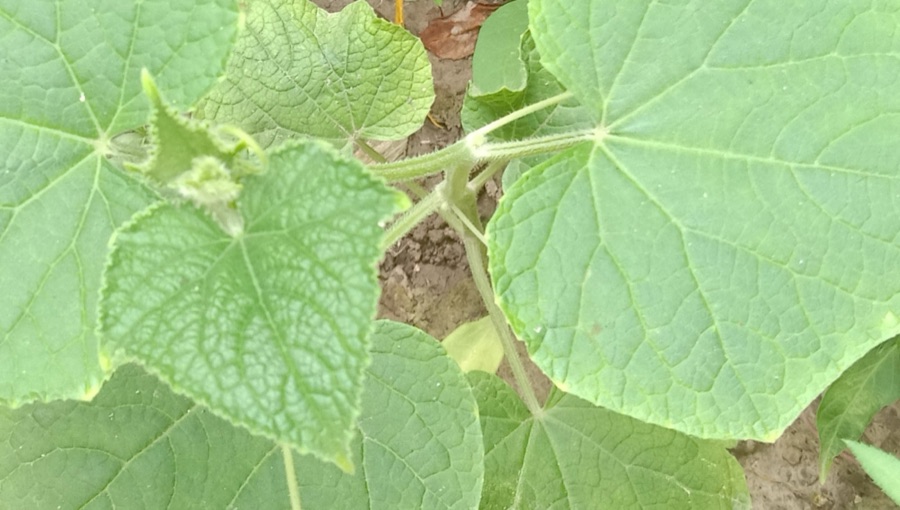
Photo: Billjones94, CC BY-SA 4.0 (Wikimedia Commons)
Cucumber is a quick, thirsty vine picked every other day, and it is farmed everywhere from open tropical plots to geothermally heated greenhouses near the Arctic circle. FAOSTAT's 2024 data, read through Wikipedia's production table, puts world output of the item 'cucumbers and gherkins' near 88 million tonnes. China grows about 78 percent of that. Turkey and Russia come next at roughly 1.7 million tonnes each, then Uzbekistan and Mexico near 1 million. In Laisha's curated research cucumber is a top-ten crop by area in 14 countries, mostly small islands, Gulf states and Cameroon. Three different products come from this one species: slicing cucumbers for fresh eating, small pickling cucumbers picked young, and seedless greenhouse cucumbers that set fruit with no pollination at all. Two diseases shape how it is grown. Bacterial wilt is carried by cucumber beetles and kills an infected vine. Downy mildew came back hard from 2004 after resistant varieties had held it back for decades. Any spray used on cucumber has to be judged against the fact that the fruit is eaten raw, often within days of picking.
Global Importance
Cucumber's top-ten list is an odd one: Pacific and Caribbean islands, desert Gulf states growing under cover, Iceland's heated glasshouses and one big open-field producer, Cameroon.
Market Segments
A cucumber buyer is really buying one of three things: a slicer, a pickler or a seedless greenhouse fruit. Fruit size, skin, seed and whether the vine grew under cover decide which, and that choice comes before the seed order.
Growth Habit
Three things about the cucumber plant drive the rest of this guide. It is a tendril vine that will climb a net or sprawl on the ground. Its flowers differ by variety, from types that need bees to types that need none. And it is fast: the first fruit can be picked a few weeks after sowing.
Growing Cucumber, Stage by Stage
- 1. Pick the market, the land and a cucurbit-free rotation — Choose slicer, pickler or greenhouse type first, then a drained field that has not carried a cucurbit for two or three seasons.
- 2. Beds, trellis and plant spacing — Shape beds, set a two-metre trellis if you will train the vines, and space plants for the market type and for plastic mulch with drip or bare ground.
- 3. Direct-seed or transplant into warm soil — Sow about 2.5 cm deep, or set out three-week-old transplants, only after the soil has warmed.
- 4. Nitrogen in two halves — Test the soil, put half the nitrogen in the bed and spoon the rest in through the drip line as the vines run.
- 5. Even watering, no swings — Hold the bed evenly moist and never let it dry out while fruit is filling, or the fruit turns bitter and crooked.
- 6. Early weeding and training the vine — Keep the first four to six weeks weed-free, then tie or tuck the vines onto the trellis or into the alley.
- 7. Flowering and pollination — Recognise male and female flowers, know which real flowering pattern your own variety carries, and support real insect pollinators unless you grow a genuine parthenocarpic type.
- 8. Cucumber beetles and aphids — The cucumber beetle matters more here than almost any other single pest in this library, because its real feeding also spreads a fatal, incurable bacterial disease, and aphids matter for the viruses they carry.
- 9. Diseases — bacterial wilt, downy mildew and other cucurbit diseases — Bacterial wilt is this crop's own single most urgent disease because it has no real cure, downy mildew is its own most historically damaging foliar disease, and both are managed mainly through prevention rather than any cure once symptoms appear.
- 10. Manage developing fruit and prevent bitterness — Keep fruit clean and growing steadily, and manage the real, genuine causes of bitter fruit before they cost you a crop's worth of quality.
- 11. Know when and how to harvest — Pick against your own real market's own size target, not by the calendar, since this crop is harvested repeatedly through the season rather than once.
- 12. Cool, grade and keep it clean — Get fruit out of the sun promptly, hold it near 13 degrees Celsius, grade it, and treat every crate as food that will be eaten raw.
Fertiliser Programme
Cucumber is fed lightly and often over a short season. Start from a soil test, put about half the nitrogen down before planting and feed the rest through the drip line, at rates well below what a big-fruited melon crop takes.
Common Problems & Troubleshooting
If you see: Sudden wilting of a single leaf on one stem, spreading through the whole plant over following days, with no recovery overnight.
It likely means: Bacterial wilt, caused by Erwinia tracheiphila. Striped and spotted cucumber beetles carry it in their gut and pass it into the plant when they feed.
Do this: Confirm the beetle connection: check nearby plants and recent history for real cucumber beetle activity.
If you see: Angular, yellowish leaf spots bounded by the leaf's own veins, with a grey-brown to purplish-black fuzzy growth on the underside in humid weather.
It likely means: Downy mildew, caused by the real water mould Pseudoperonospora cubensis, a disease that broke through decades of effective resistance breeding in a well-documented resurgence beginning in 2004.
Do this: Check the underside of suspect leaves specifically, since the fuzzy growth appears there first, not on the upper leaf surface.
If you see: Round white talc-like spots on the oldest leaves, joining up until the leaf looks dusted with flour.
It likely means: Powdery mildew, a common fungus of cucumber and its relatives that strips the leaves feeding the fruit.
Do this: Thin crowded vines and train them up a trellis so air moves through the canopy.
If you see: Leaves mottled light and dark green, a stunted growing tip, and pale warty fruit that buyers call 'white pickles'.
It likely means: Cucumber mosaic virus, a real virus documented as having the widest host range of any known plant virus, over 1,200 real plant species, spread by more than 80 real aphid species.
Do this: Accept that an infected vine stays infected. The only lever is stopping aphids from bringing the virus in.
If you see: A sharp, unpleasant bitter taste when the fruit is eaten, usually strongest near the stem end.
It likely means: Cucurbitacin compounds, a real, genuine quality problem in this crop most often caused by heat or water stress, real temperature swings of more than 20 degrees Fahrenheit, or cross-pollination with a wild cucurbit relative.
Do this: Keep watering genuinely even through the season, since inconsistent moisture is a real, documented cause (Stage 5, Stage 10).
If you see: Tiny cucumbers that go yellow and shrivel at the end of the flower instead of growing, on a vine that looks healthy.
It likely means: The female flower was not pollinated in the one day it was open. Common causes are too few bee visits, an insecticide that killed the bees, a gynoecious variety sown without its pollenizer seed, or simply the early run of male flowers.
Do this: Check the seed packet: a gynoecious type needs 10 to 15 percent pollenizer seed in the mix, while a parthenocarpic type needs no bees at all.
If you see: Chewed holes in cotyledons and young leaves soon after emergence, sometimes with small beetles visible on close inspection.
It likely means: Direct feeding damage from the striped or spotted cucumber beetle, a real risk to a young seedling even before any bacterial wilt symptom appears.
Do this: Check seedlings closely and often in the first weeks after emergence, when a young plant is most vulnerable.
Real Farm Economics
United States extension budgets give one detailed picture of what a commercial cucumber acre costs, and Laisha's 14-country data shows how much more a heated greenhouse can yield than an open field.
Yield & Market Value
A cucumber crop is weighed in crates picked every other day for weeks, and priced by size class. This section covers what a normal harvest weighs and how to find what each class is worth.
Remember It This Way
If you forget every other page of this guide, keep these lines. They are the whole crop, in order, short enough to carry in your head.
- Decide your real market first. Slicing, pickling and greenhouse cucumbers are three different jobs.
- A different plant from watermelon and melon. Same family, different genus or different species.
- The first flowers on the vine are male. They will never become fruit, and that is normal.
- Spray when bees are not flying, and never on open cucumber flowers.
- Watch the beetle, not just the wilt. It carries a disease with no real cure at all.
- Pick often, never let one fruit oversize. An unpicked fruit tells the whole vine to slow down.
- Bitterness is a quality problem here, not a poison. Uneven water and heat are the real cause.
- Wash hands and fruit before eating raw. This crop has a real, documented safety history.
Test Yourself: Identification
What crop is this creeping, leafy vine?
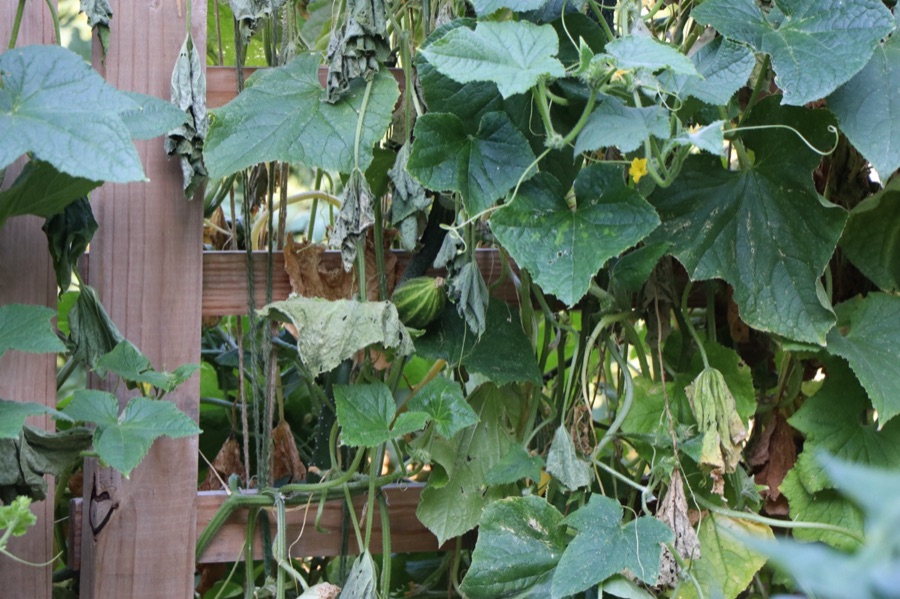
What is this crop doing, growing up a wooden support like this?
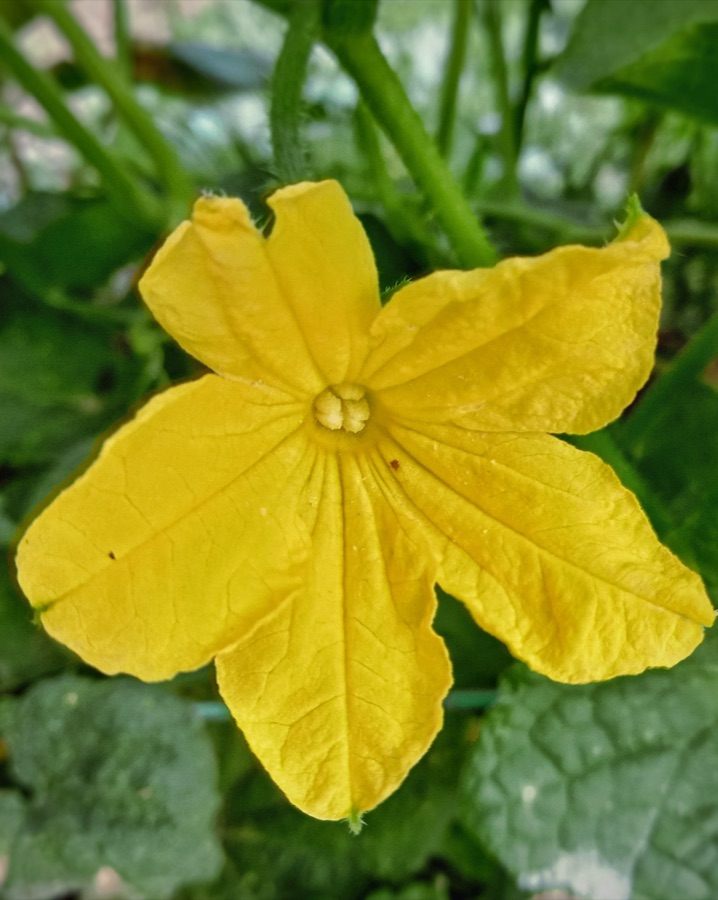
Is this cucumber flower male or female?
Honest Limits of This Guide
- No month is given for sowing. Sow when your own frost risk is over and the soil at 8 cm depth holds 15.5 degrees Celsius.
- We could not independently confirm one single universal open-field commercial yield figure in tons or pounds per acre for this crop, unlike several other crops in this library, and uses Laisha's curated 14-country per-hectare data honestly instead.
- We could not confirm whether FAOSTAT's own single 'Cucumbers and gherkins' item line blends any real Cucumis anguria (West Indian gherkin) tonnage into this crop's own figures, and states that gap honestly rather than asserting a precise split.
- The 10 to 15 percent pollenizer share for gynoecious cucumbers comes from one United States extension publication; seed companies may blend differently, so read your own seed lot's label.
- How much dearer seedless greenhouse cucumber seed is than field seed was not confirmed, only that the structure and the seed both cost more.
- Laisha's seed-certification reference has no Indian Minimum Seed Certification Standards entry for cucumber.
- No single checked world area or world average cucumber yield is given; Laisha's country-level data is used in its place.
- No cucumber spray product or active ingredient is named. If one is needed, choose by IRAC or FRAC group with a licensed dealer and follow the label and its pre-harvest interval.
Related Laisha Tools
- Global Market Price Outlook — Check today's price and trend
- Crop Calendar — Build a season-long sowing plan
- Pest & Disease Intelligence — Risk reasoning and a global pest & disease library
- Crop Health — Photo-based first read on a field problem
- Post-Harvest Loss Prevention — Real storage science by crop
Sources
- GBIF Backbone Taxonomy species-match record for Cucumis sativus L. — Global Biodiversity Information Facility (GBIF), Copenhagen (source)
- EPPO Global Database taxon record for Cucumis sativus, code CUMSA — European and Mediterranean Plant Protection Organization (EPPO), Paris (source)
- GBIF Backbone Taxonomy species-match record for Cucumis anguria L. — Global Biodiversity Information Facility (GBIF), Copenhagen (source)
- Wikipedia: Cucumber — Wikimedia Foundation, citing FAOSTAT and other primary sources (source)
- Wikipedia: Cucumber mosaic virus — Wikimedia Foundation (source)
- Wikipedia: Erwinia tracheiphila — Wikimedia Foundation (source)
- Wikipedia: Pseudoperonospora cubensis — Wikimedia Foundation (source)
- Wikipedia: Cucurbitacin — Wikimedia Foundation (source)
- Wikipedia: Agriculture in Iceland — Wikimedia Foundation (source)
- Wikipedia: List of foodborne illness outbreaks in the United States — Wikimedia Foundation (source)
- Selecting and Serving Produce Safely — U.S. Food and Drug Administration (source)
- Cucumber Production — Pennsylvania State University Extension (source)
- Cucumber (home garden fact sheet) — Clemson University Cooperative Extension, Home & Garden Information Center (source)
- Global Crop Priority Research — Laisha internal reference data set, built on FAOSTAT (source)
- Global Seed Certification Standards, cucumber entries — Laisha internal reference data set, compiled from the primary legal instruments it cites (source)
- Laisha's own curated agrochemical mode-of-action and toxicity colour-band reference — Laisha (internal curated research) (source)
- Bee Pollination of Cucurbit Crops (G1754), by Laurie Hodges and Fred Baxendale — University of Nebraska–Lincoln Extension, Lincoln (source)
Last updated · How Laisha writes and checks its pages · Report a mistake
Go further with Laisha Smarter
US$10 a month · one price worldwide · cancel any time
- Your own crop calendar for this crop, stage by stage
- Pest and disease alerts with IRAC/FRAC-group spray plans
- Ask Laisha about your field — up to 1,000 questions a month
| Free | Smarter | |
|---|---|---|
| Grow guides, pest pages, articles | Read all | Read all |
| Ask Laisha | 5 a day | Up to 1,000 a month |
| Exam practice | The sample on each page | Every question, timed papers |
| Crop calendar and pest alerts | — | For your own fields |
| Calculators and tools | — | All |
| Uploads and reports | — | 100 a month, real files |