How to Grow Orange
Citrus sinensis · Also called: sweet orange, orange tree, naranjo dulce, naranja, laranjeira, arancio, Apfelsine, oranger
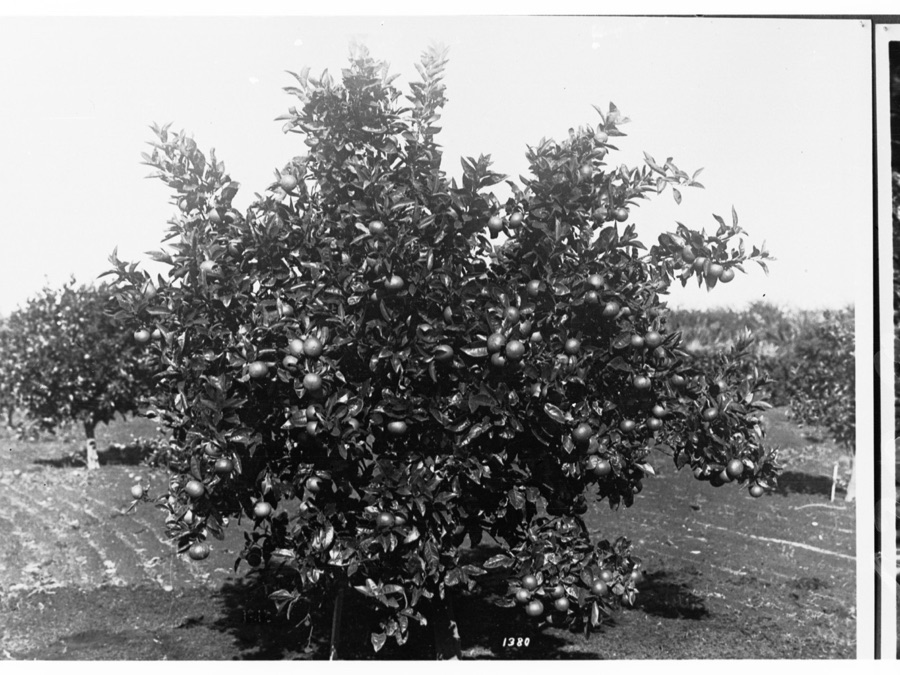
Photo: State Government Photographer, CC0 (Wikimedia Commons)
Sweet orange is the citrus the world drinks. About 67 million tonnes were grown in 2024, and Brazil alone grew close to a quarter of it, most of it squeezed for juice that is shipped abroad. Laisha's crop-priority research places orange in the top ten crops of 22 countries, from the Caribbean and Central America to North Africa, the Middle East, southern Africa and southern Europe, yet it is the biggest crop in none of them. A grove is planted once and picked for twenty years or more. Every tree is two plants joined at a bud union: a named fruiting variety such as Valencia, Hamlin or a navel, sitting on a rootstock picked for the soil. One disease now decides how oranges are grown almost everywhere. Huanglongbing, or citrus greening, is carried by a small psyllid insect, has no cure, and has halved Florida's orange crop since 2005. Any spray you use on oranges must come from a licensed dealer and be used exactly as its label says.
Global Importance
Brazil, China and Mexico grow the most oranges. Brazil turns most of its crop into juice for export, which is why orange juice concentrate trades on a futures market while most other fruit does not.
Market Segments
An orange crop is sold two main ways. Juice plants pay for sugar and juice weight and forgive a scarred skin. The fresh trade pays more per kilo but grades every fruit for size, colour and blemish. Peel oil and orange-blossom honey are small extras.
Growth Habit
An orange tree is an evergreen that can bear for decades. You never plant the seed; you buy a budded tree, and the rootstock under the bud decides how the tree copes with wet soil, lime, cold, tristeza virus and root rot. Varieties are chosen by picking season, from early Hamlin and navels to late Valencia, and the whole grove is planned around keeping the greening psyllid out.
Growing Orange, Stage by Stage
- 1. Pick frost-light, free-draining land — Choose warm ground that drains after the heaviest rain, test the pH, plan rows that a tractor can pass, and ask whether greening, its psyllid, Phytophthora or root weevils are already in the area.
- 2. Buy certified budded planting material on a chosen rootstock — Get the scion and the rootstock named in writing, from a nursery that grows under insect-proof cover with tested budwood, and match the rootstock to your soil and to tristeza in your district.
- 3. Plant out the young trees — Set each tree at the depth it grew in the nursery, with the bud union clear of the soil, build a basin that holds 20 to 40 litres, fill it at once, and plant at the start of the rains where you rely on rain.
- 4. The first three to four years, before the first crop — Pinch off early flowers, cut away any shoot from below the bud union, build three or four main limbs, and grow a short food crop between rows while you wait.
- 5. Water by age and by bloom — Water a new tree twice a week at first, then whenever the new leaves wilt by mid-afternoon. A bearing tree needs steady moisture from bloom until the fruit sizes, and never a wet trunk base.
- 6. Weed the trunk circle and feed by tree age — Keep weeds and mulch off the trunk, because foot rot starts there. Spread fertiliser past the drip line, about as many feet beyond it as the tree is years old, and raise the dose each year.
- 7. Bloom and fruit set — Orange blooms on the spring flush. Navels are shy bearers, and navel and Valencia blossoms are prone to postbloom fruit drop in rainy weather, so judge the set a few weeks after the petals fall.
- 8. Hedge and shape the bearing grove — Mature orange trees need little canopy pruning. Light, regular hedging keeps the rows open for spraying and picking, and water sprouts and rootstock suckers come off on every visit.
- 9. Scout the flush for psyllids, leafminer and canker — The young flush is where greening, canker and leafminer start. Look at new shoots every week while they are soft, and remove a tree with confirmed greening before it infects the block.
- 10. Know when to harvest — An orange does not get sweeter after picking, and a green-skinned orange in the tropics can be fully ripe. Judge by taste and juice tests from the variety's own season, not by colour.
- 11. Clip, never pull — Cut each fruit with clippers close to the button, so the rind is not torn and no sharp stub punctures the fruit next to it in the crate.
- 12. Grade, cool, store and send to juice or fresh — Send blemished fruit to the juice plant and well-coloured, sound fruit to the fresh market. Cool storage slows rot; it cannot ripen the fruit further.
Fertiliser Programme
Feed each orange tree by its age. Indian guidance starts a first-year tree on about 10 kg of manure with 0.2 kg nitrogen, and settles at about 30 kg manure and 0.6 kg nitrogen from year six. Florida's table rises from about 0.15 to 0.3 lb of nitrogen in year one to 1.1 to 1.4 lb from year five, in three doses a year.
Common Problems & Troubleshooting
If you see: Leaves with yellow blotches that are different on each side of the midrib, yellow shoots in one part of the canopy, and small lopsided oranges that stay green at the stem end and taste bitter.
It likely means: Huanglongbing (citrus greening), a bacterial disease in the tree's sap-carrying tissue. The Asian citrus psyllid spreads it from tree to tree, and infected budwood spreads it between regions.
Do this: Have the tree tested by your plant health service. A confirmed tree should come out, because it keeps feeding psyllids that carry the bacterium to its neighbours.
If you see: Tiny mottled brown insects, about 3 to 4 mm long, sitting tail-up on soft new shoots, with curly white waxy threads and twisted young leaves around them.
It likely means: Asian citrus psyllid, Diaphorina citri. Its feeding twists the flush, but the bigger harm is that it carries greening.
Do this: Check every new flush, keep flushing short and even, plant tree windbreaks that slow psyllids drifting in, and remove orange jasmine hedges near the grove.
If you see: Orange trees on sour orange rootstock with small leaves, twig dieback and shrinking fruit, or trees that wilt and die within weeks. A bark flap cut across the bud union shows tiny pits on the rootstock side.
It likely means: Tristeza decline, caused by citrus tristeza virus moved by aphids, especially the brown citrus aphid. Sweet orange on sour orange rootstock is the classic casualty.
Do this: Replant on a tristeza-tolerant rootstock recommended for your soil, and buy only certified budwood.
If you see: Corky, crater-like spots with a yellow ring on leaves, twigs and peel, worst on the side of the tree that takes wind-driven rain, and on early oranges such as Hamlin.
It likely means: Citrus canker, a bacterial disease spread by wind-driven rain, wet equipment and crews, and helped in through leafminer tunnels. Orange fruit can be infected for the first 60 to 90 days after petal fall.
Do this: Protect the new flush and the young fruit through that window with the copper programme your extension service sets, and clean equipment and crews between blocks.
If you see: Silvery, snaking trails inside young orange leaves, which curl around the trail.
It likely means: Citrus leafminer, the larva of a tiny moth that only attacks soft new leaves.
Do this: Time any treatment to the young flush, and do not worry about hardened leaves; trees older than about three years tolerate the damage.
If you see: Older orange trees that slowly lose size and leaf, with small fruit, even though water and feed are right.
It likely means: Feeding by the citrus root nematode, or root rot from Phytophthora in poorly drained ground. Both look alike from above.
Do this: Send soil and root samples for a nematode and Phytophthora test before you spend on fertiliser.
If you see: Small, narrow, pale new leaves held upright in rosettes, with the same pattern on both halves of each leaf.
It likely means: Zinc deficiency, called little leaf. The even, mirror-image yellowing is what separates it from greening.
Do this: Spray zinc on the new flush and at flowering, and test the leaves again the next season.
Real Farm Economics
An orange grove costs money for three or four years before the first box is sold. Florida guidance now favours denser planting, up to about 300 trees an acre, because it pays back sooner while greening shortens how long a tree stays profitable, even though each tree yields less.
Yield & Market Value
Orange yield is counted per tree and per box, and juice plants pay on sugar per box, not on looks. Laisha's live commodity price service does not track orange yet, so ask the juice plant or packhouse for its price basis before harvest.
Remember It This Way
Eight lines for an orange grove, from nursery to crate.
- Never plant the pip. Buy a budded tree with both names on the label.
- Pick the rootstock for your soil and for tristeza, because you cannot change it later.
- Yellow blotches that differ on each side of the vein mean test for greening now.
- A green orange can be ripe. Taste before you pick.
- Once picked, it never gets sweeter. Pick it right the first time.
- Clippers, not hands. Cut the stem flat at the button.
- Blemished fruit goes to juice. Clean, coloured fruit goes fresh.
- One mutant tree in Brazil, two centuries ago, is why your navel orange has no seeds.
Test Yourself: Identification
Which crop is this, rows of round evergreen trees about head height, hedged flat on the sides so a tractor can pass?
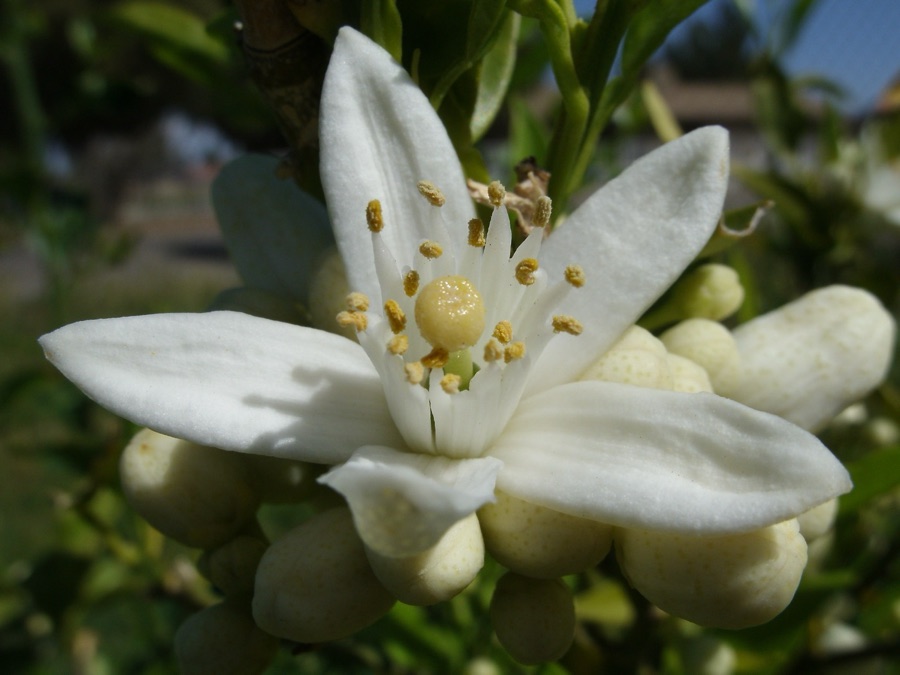
Which tree has these waxy white spring blossoms, the flower behind a well-known honey?
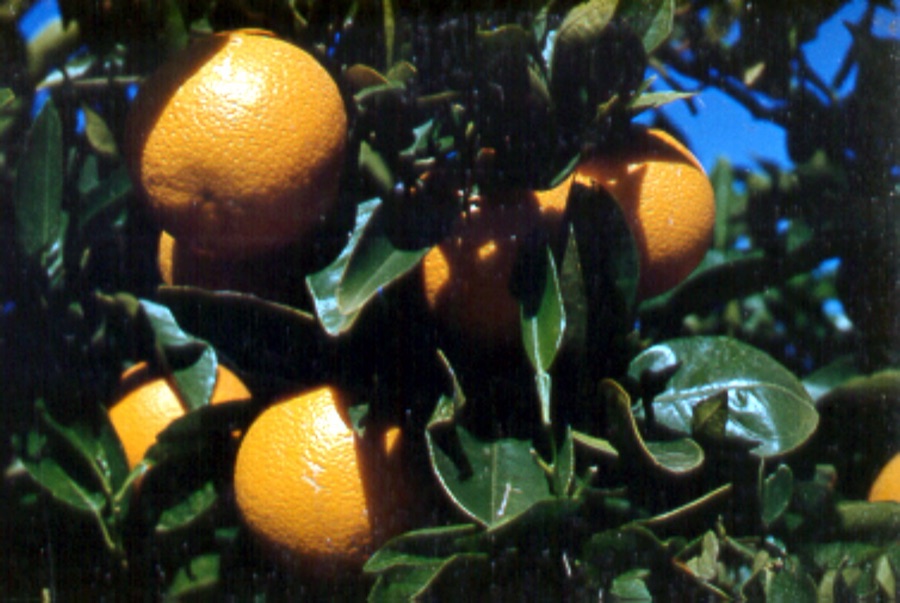
Which fruit is this, hanging in clusters, still green-orange on the tree yet already sweet enough to pick?
Honest Limits of This Guide
- The world orange total of about 67 million tonnes comes from a published article that cites FAOSTAT for 2024. It was not re-queried from FAOSTAT for this page.
- The yield range here comes from Laisha's research across the 22 countries where orange is a top-ten crop, plus Indian state guidance. There is no single world figure per tree, and Brazilian juice groves and small mixed orchards are very different.
- We found no cost-of-production study that fits orange groves everywhere. Florida's costs now include psyllid control and tree replacement that a grower in a greening-free area does not carry, so no cost per hectare is given.
- No spray product or active ingredient is named for orange. Where a spray is mentioned, it is by its insecticide or fungicide mode-of-action group, and your local label decides what may be used.
- The toxicity colour on a spray label depends on the product, its formulation and your country. Read it on the pack you buy; this page cannot tell it for you.
- Rules for certified citrus nursery trees differ by country. Florida runs a budwood certification programme; many places have none, so ask your agriculture department what exists where you farm.
- The feeding doses are one Indian state's schedule and one Florida table, given side by side. Your leaf and soil tests should set the real dose.
- Legal maturity tests for oranges, set as sugar, acid and juice minimums, differ by country and season. This page does not give one universal figure.
- Picking seasons and the three-to-four-year wait for a first crop are shown as ranges. Florida picks Hamlin from October and Valencia until June; your season will be set by your own climate.
Related Laisha Tools
- Global Market Price Outlook — Check today's price and trend
- Crop Calendar — Build a season-long sowing plan
- Pest & Disease Intelligence — Risk reasoning and a global pest & disease library
- Crop Health — Photo-based first read on a field problem
- Soil Health — Track soil test results across seasons
Sources
- GBIF Backbone Taxonomy species-match record for Citrus sinensis (Mill.) Pers. (usage key 3190158) — Global Biodiversity Information Facility (GBIF), Copenhagen (source)
- World Checklist of Vascular Plants (WCVP) search results for Citrus sinensis, queried live through GBIF's own hosted copy of the checklist — Royal Botanic Gardens, Kew, hosted via GBIF (dataset f382f0ce-323a-4091-bb9f-add557f3a9a2) (source)
- EPPO Global Database record for Citrus x aurantium var. sinensis (EPPO code CIDSI) — European and Mediterranean Plant Protection Organization (EPPO) (source)
- Orange (fruit) — Wikipedia, citing FAOSTAT production data (source)
- Citrus x sinensis — Wikipedia (source)
- Navel orange — Wikipedia (source)
- Nucellar embryony — Wikipedia (source)
- Citrus greening disease (Huanglongbing) — Wikipedia (source)
- Diaphorina citri (Asian citrus psyllid) — Wikipedia (source)
- Citrus tristeza virus — Wikipedia (source)
- Citrus canker — Wikipedia (source)
- Citrus leafminer — Wikipedia (source)
- Phytophotodermatitis — Wikipedia (source)
- Orange juice — Wikipedia (source)
- Laisha's own curated global crop build-priority research, built on FAOSTAT's own 'Oranges' item category — Laisha (internal curated research, sourced from FAOSTAT QCL 2025) (source)
- Sweet orange cultivation guidelines — Tamil Nadu Agricultural University (TNAU) Agritech Portal (source)
- Laisha's own curated agrochemical mode-of-action and hazard-band reference — Laisha (internal curated research) (source)
- Laisha's own curated seed-certification standards research — Laisha (internal curated research) (source)
- 2026–2029 Florida Citrus Production Guide: Fundamentals (EDIS CG101), including the chapters on rootstock and scion selection, grove planning and nutrition — University of Florida, Institute of Food and Agricultural Sciences (UF/IFAS) Extension, Gainesville (source)
- Citrus Culture in the Home Landscape (EDIS HS-867) — University of Florida, Institute of Food and Agricultural Sciences (UF/IFAS) Extension; R. E. Rouse and M. Zekri (source)
Last updated · How Laisha writes and checks its pages · Report a mistake
Go further with Laisha Smarter
US$10 a month · one price worldwide · cancel any time
- Your own crop calendar for this crop, stage by stage
- Pest and disease alerts with IRAC/FRAC-group spray plans
- Ask Laisha about your field — up to 1,000 questions a month
| Free | Smarter | |
|---|---|---|
| Grow guides, pest pages, articles | Read all | Read all |
| Ask Laisha | 5 a day | Up to 1,000 a month |
| Exam practice | The sample on each page | Every question, timed papers |
| Crop calendar and pest alerts | — | For your own fields |
| Calculators and tools | — | All |
| Uploads and reports | — | 100 a month, real files |