Pollinators: Why Your Crop Needs Them, Why They Are Declining and How to Protect Them
About three quarters of the leading food crops benefit from animal pollinators, and 5-8 % of global crop production is directly due to them (IPBES, 2016). This guide covers which crops depend on pollinators and how much, honey bees, wild bees and other pollinators, what the evidence on pollinator decline really shows, the five interacting drivers (habitat loss, pesticides including neonicotinoids (IRAC group 4A), Varroa and diseases, climate change, invasive species), bee-safe spraying, flower strips and nesting sites, other beneficial insects, and managed pollination with hive stocking rates and pollinizers.
Chapters
- 0:00The workers you do not pay
- 1:32Which crops need them
- 2:43Who does the work
- 4:06Are pollinators declining?
- 5:15What is driving it
- 6:44Spraying without killing them
- 7:51Food and homes on the farm
- 9:01Managing pollination
- 10:26Recap
Transcript
Most talk about insects on a farm is about pests. Yet most insect species do crops no harm at all, and many are essential.
Bees, flies, beetles, butterflies and moths carry pollen from flower to flower, and without them, many fruits, vegetables, nuts, oilseeds and spices would yield little or nothing.
The global assessment by IPBES in twenty sixteen found that about three quarters of the leading food crop types benefit to some extent from animal pollination.
Those crops make up about thirty-five per cent of global crop production by volume, and between five and eight per cent of all crop production is directly due to animal pollinators, worth roughly two hundred and thirty-five to five hundred and seventy-seven billion US dollars a year. They also supply much of the vitamin A, vitamin C,
folate and other micronutrients in our diets.
In this video: which crops need pollinators, who the pollinators are, what the evidence on decline really shows, the drivers, how to spray without killing them, how to give them food and homes on your farm, and how to manage pollination for better yields. The advice is general and global.
Pollination moves pollen from the male parts of a flower to the female parts.
Cereals such as wheat, rice, maize and barley are pollinated by wind or by themselves, and need no animals. But dependence on animals ranges right up to essential.
Melons, pumpkins, cocoa and kiwifruit would yield little without pollinators.
Almond, apple and cherry depend on them greatly.
And many crops, such as mustard, sunflower, soybean and coffee, still gain ten to forty per cent in yield and quality from good pollination.
Quality matters too.
Well-pollinated apples, strawberries and cucurbits are larger and better shaped, because each fertilised seed stimulates the tissue around it to grow. That is why a poorly pollinated fruit is often lopsided.
And even a self-fertile variety often still needs a visitor, at least partly, to move pollen within the flower.
Insect visits usually improve fruit set and quality.
The honey bee is the main managed pollinator:
the western honey bee in most of the world, and the eastern honey bee in Asia. It is easy to move in hives to a crop in flower.
Almond orchards in California alone use well over a million hives each spring.
But there are about twenty thousand species of wild bees worldwide.
Bumble bees, mason bees, carpenter bees, stingless bees and many solitary bees that nest in the ground.
Bumble bees are even reared commercially for greenhouse tomatoes,
which they buzz-pollinate, shaking the pollen loose.
Many wild bees are more efficient per visit than honey bees for particular crops.
Beyond bees, hoverflies and other flies, beetles, butterflies and moths all pollinate, and tiny midges are the main pollinators of cocoa.
Birds and bats pollinate some crops, such as durian and agave.
Here is the key finding.
A study across forty-one crop systems worldwide showed that wild insects increased fruit set regardless of how many honey bees were present.
Honey bees supplement wild pollinators.
They do not replace them.
The picture is mixed, and it differs between managed and wild pollinators.
The global number of honey bee hives has actually increased over the past fifty years, driven by beekeeping in Asia, Africa and South America.
But some regions report heavy colony losses.
In the United States, beekeepers have often lost thirty to fifty per cent of their colonies in a year since the mid two thousands, replacing them at extra cost.
Wild pollinators are a different story.
Long-term data from Europe and North America show declines in the range and abundance of many wild bees, bumble bees, hoverflies and butterflies,
and several species are now listed as threatened.
Data from the tropics are much sparser.
And field studies show that many crops already yield less than they could, because of too little pollination, especially in intensively farmed landscapes with little natural habitat.
Five drivers act together.
First, habitat loss: meadows, forests, hedges and field margins converted to large monocultures remove nesting sites and flowers,
and a mass-flowering crop gives only a brief pulse of food.
Second, pesticides.
Insecticides sprayed on flowering crops, or drifting onto flowers, kill bees.
The neonicotinoids, IRAC group four A, can also harm bees at doses that do not kill them, affecting navigation, foraging and colony growth.
The European Union restricted three of them in twenty thirteen,
and banned their outdoor use in twenty eighteen.
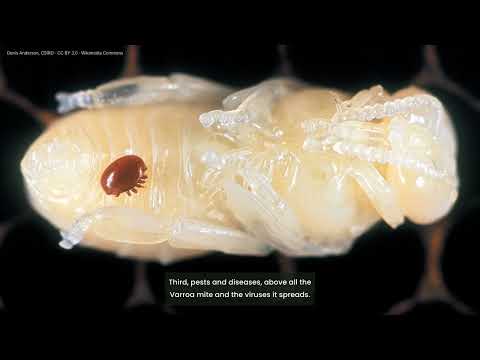
Third, pests and diseases, above all the Varroa mite and the viruses it spreads.
Diseases can also spill over from managed bees to wild ones.
Fourth, climate change, which shifts flowering and pollinator activity out of step, and pushes some bumble bees out of the southern edges of their ranges.
And fifth, invasive species, such as the Asian hornet in Europe.
These stresses add up.
A bee weakened by poor nutrition is more vulnerable to pesticides and disease. So no single cause explains the decline, and no single fix will reverse it.
You can protect pollinators without giving up crop protection.
Use integrated pest management, and spray only when a threshold is crossed.
Do not spray insecticides on crops in flower. If it cannot be avoided, choose products less toxic to bees, and spray in the evening, when bees are not foraging.
Read the label for bee warnings, including warnings on systemic seed treatments.
Many insecticides are highly toxic to bees, including the neonicotinoids, fipronil, and many pyrethroids and organophosphates.
And warn nearby beekeepers before you spray, so they can close or move their hives.
Is it safe to spray when no bees are visible?
Not necessarily.
Bees may arrive later, and residues on flowers can stay toxic for hours or even days.
So spray outside flowering where you can, and check the label for how long the product stays toxic to bees.
Pollinators need food all season, and somewhere to nest.
Sow flower strips, keep hedgerows and field margins,
plant trees on the farm, and grow cover crops.
Rotate and diversify your crops, so something is flowering over a long season, not just for two weeks a year.
And leave some bare, undisturbed ground and dead wood, because many wild bees nest in the soil or in old wood.
The same habitat also feeds other beneficial insects.
Dung beetles bury livestock dung, recycling its nutrients and reducing pasture flies.
Termites and other insects break down plant material.
Some insects even control weeds: a moth, Cactoblastis, cleared invasive prickly pear from millions of hectares in Queensland and New South Wales in the late nineteen twenties and thirties. Insects give us honey, wax, silk and lac.
And the predators and parasitoids that eat pests, which we cover in our next video.
Where wild pollinators are too few, manage pollination.
Place honey bee colonies at the start of flowering, at the right density.
Typical figures are about three colonies per hectare in mustard,
and five or more in apple.
Almonds are usually stocked at around five hives per hectare. In orchards, plant pollinizer varieties, so there is compatible pollen for the bees to carry.
And in greenhouses and tunnels, use bumble bees or stingless bees.
Is it worth it? Here is the logic from Laisha's worked example. If apples have a pollinator dependence of zero point six five,
about sixty-five per cent of the crop's value can be attributed to pollination.
In the example, renting hives at flowering cost less than one point two per cent of that value.
Real figures vary by crop, variety and region, but the gap is usually wide.
Can people or machines do the job instead?
Only on a small scale.
Hand pollination is used in some apple and pear orchards in China and in vanilla, but it takes a lot of labour. Robotic and drone pollination remain experimental.
Wild and managed pollinators do it far more cheaply.
To recap.
About three quarters of leading food crops benefit from animal pollinators,
and they supply much of our vitamins.
Cereals need none, but melons, pumpkins, cocoa and kiwifruit depend on them almost entirely.
Honey bees help, but wild bees and other insects add pollination that honey bees cannot replace.
Many wild pollinators are declining, from habitat loss, pesticides, Varroa and disease, climate change and invasive species, acting together. So spray only when needed, never on crops in flower, choose products less toxic to bees and warn beekeepers.
Keep flowers and nesting sites all season, and place hives and pollinizers at flowering.
For the full explainers and our crop guides, visit laisha.ai. Thank you for watching.
Last updated · How Laisha writes and checks its pages · Report a mistake
Go further with Laisha Smarter
US$10 a month · one price worldwide · cancel any time
- Ask Laisha about what you watched — up to 1,000 questions a month
- Your own crop calendar and pest alerts
- Every calculator and tool