The first 6 weeks decide your wheat: weed control
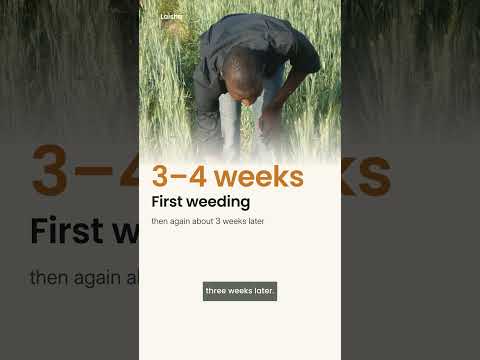
Weeds hurt wheat most in the first 6 to 8 weeks. Weed at 3 to 4 weeks and again about 3 weeks later. Grass weeds like Phalaris minor look like wheat: pull them before they seed. Herbicides: choose by HRAC group, follow the label. The full video covers the critical period, HRAC herbicide groups, resistance and safe spraying.
Weed management and the critical period of crop–weed competition →
The critical period of weed control
Weeds that come up with a crop compete for light, water and nutrients. The yield loss they cause depends less on how long they are present than on when. The critical period of weed control is the window during which the crop must be kept weed-free to avoid more than an acceptable loss, often taken as 5 per cent. Before it, the crop is small and weeds do little harm; after it, the crop canopy is strong enough to suppress late weeds. For wheat in South Asia and many other regions, research places this period at roughly the first 30 to 45 days after sowing, extending to about 60 days in some conditions. Weeds removed in this window protect most of the yield; weeds removed after it have already done much of their damage.
Grass weeds that hide in wheat
Little seed canary grass (Phalaris minor) and wild oat (Avena fatua and A. ludoviciana) are the most serious grass weeds of wheat in north India and Pakistan, and wild oats and ryegrass are major problems in many other countries. Young plants look very like wheat. Ways to tell them apart in the seedling stage: Phalaris minor has a reddish-pink base and a large, membranous ligule with no auricles; wheat has a green base with small, hairy auricles clasping the stem. Wild oat leaves twist anticlockwise when seen from above, have no auricles and often have hairs on the leaf margin, while wheat leaves twist clockwise.
Broadleaf weeds such as Chenopodium album, Melilotus, Rumex, Anagallis and Convolvulus are easier to see and often controlled with different herbicides.
Weeding methods
Hand weeding or hoeing at about 3 to 4 weeks after sowing, and again about three weeks later, removes most competition in small fields. Line sowing with a seed drill makes hoeing between rows easier. Higher seed rates, narrower rows and early sowing help the crop close its canopy sooner. Zero-till sowing into rice residue reduces Phalaris minor emergence in rice-wheat systems, because the weed germinates more from disturbed soil.
Herbicides and resistance
Herbicides for wheat are applied pre-emergence (soon after sowing) or post-emergence (usually 30 to 35 days after sowing, when weeds have 2 to 4 leaves). Choose products registered for the weeds present, and follow label rates, timing and water volume carefully. Phalaris minor in north-west India developed resistance to isoproturon in the 1990s and later to some ACCase and ALS inhibitors, causing severe yield losses. Rotating herbicides with different HRAC (mode-of-action) groups, using mixtures where recommended, and combining herbicides with cultural methods slow resistance. Stop weeds setting seed: a single wild oat or Phalaris plant can shed hundreds to thousands of seeds.
Transcript
The first six weeks decide how much of your wheat the weeds will take.
Weeds hurt wheat most in the first six to eight weeks after it comes up. So weed early: by hand or with a hoe at three to four weeks, and again about three weeks later.
Watch for grass weeds like Phalaris minor and wild oats. Young, they look almost exactly like wheat.
Learn your crop's leaf, and pull them before they set seed, because one weed can drop thousands of seeds.
If you use a herbicide, choose it by HRAC group, follow the label dose and timing, and rotate groups.
The full guide is in our long video and at laisha.ai.
Last updated · How Laisha writes and checks its pages · Report a mistake
Go further with Laisha Smarter
US$10 a month · one price worldwide · cancel any time
- Ask Laisha about what you watched — up to 1,000 questions a month
- Your own crop calendar and pest alerts
- Every calculator and tool