Tomato spotted wilt virus (TSWV)
Tomato spotted wilt virus ICTV species: Orthotospovirus tomatomaculae · formerly or also: TSWV
- virus del bronceado del tomate · Spanish, Spain and Latin America
- vira-cabeça do tomateiro · Portuguese, Brazil
- maladie bronzée de la tomate · French, France
- 番茄斑萎病毒 (fānqié bān wěi bìngdú) · Chinese, East Asia
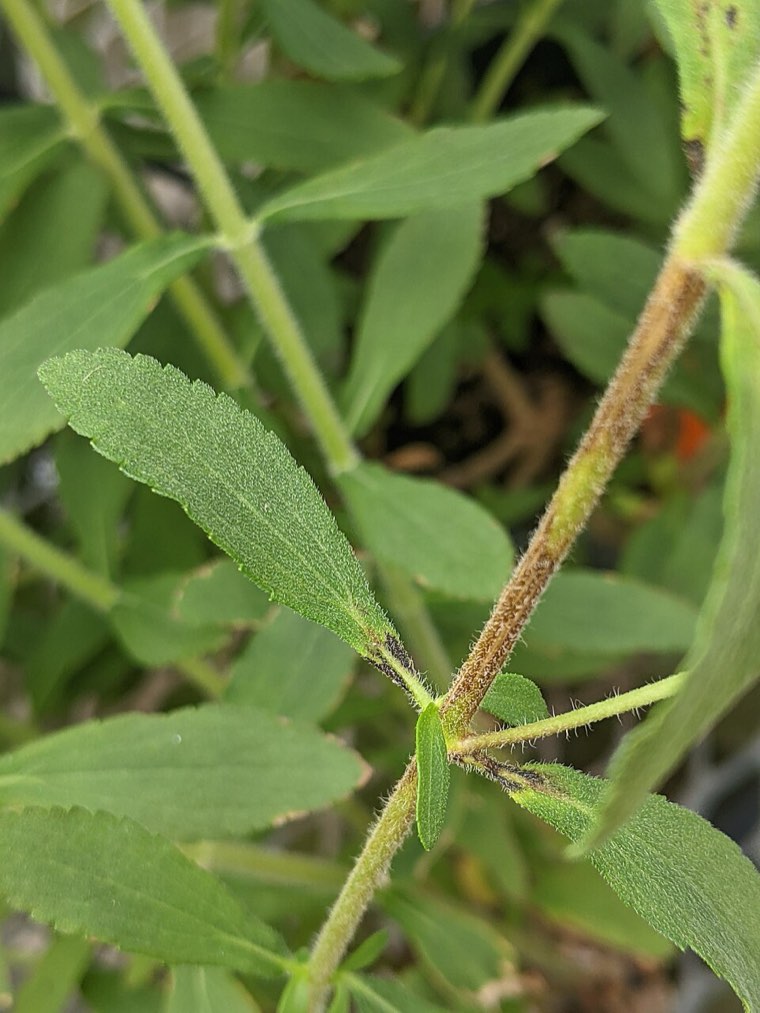
Tomato spotted wilt virus has one of the widest host ranges of any plant virus - more than 1,000 plant species - and causes serious losses in tomato, pepper, lettuce, groundnut, tobacco and ornamentals. Thrips spread it: young thrips larvae pick it up and the adults carry it for life. Infected tomato plants develop bronzed leaves with dark spots, stop growing, and produce fruit with yellow and red rings.
- Type
- Virus disease · Virus (orthotospovirus with an RNA genome), spread by thrips
- Classification
- Bunyavirales (Elliovirales) › Tospoviridae › Orthotospovirus
- Main crops
- Tomato, Chilli & sweet pepper, Lettuce, Groundnut, Tobacco, Ornamentals
- Found in
- Americas, Europe and the Mediterranean, Asia, Africa and Oceania
- Chemical groups
- IRAC 5, IRAC 28 (mode-of-action groups, not products)
- Last reviewed
- 2026-10-20
What causes tomato spotted wilt virus?
Tomato spotted wilt virus is caused by Tomato spotted wilt virus, a virus (orthotospovirus with an RNA genome), spread by thrips (order Bunyavirales (Elliovirales), family Tospoviridae).
Older or alternative scientific names: TSWV.
Where it occurs
Found worldwide in temperate, subtropical and tropical regions, outdoors and in greenhouses; its spread since the 1980s followed the global spread of the western flower thrips.
| Region | Status |
|---|---|
| Americas | Widespread; major in groundnut, tomato and tobacco |
| Europe and the Mediterranean | Widespread in vegetables and ornamentals |
| Asia | Widespread; related tospoviruses also common |
| Africa and Oceania | Present |
Symptoms and identification of tomato spotted wilt virus
The organism
An enveloped RNA virus detected by ELISA, lateral-flow strips or RT-PCR. Transmitted by thrips - mainly Frankliniella occidentalis, F. fusca and Thrips tabaci - in a persistent, propagative way: larvae acquire the virus, which multiplies in them, and adults transmit it for life. Not seed-transmitted in tomato. Adult thrips that feed on an infected plant without having acquired the virus as larvae do not become infective, which is why virus-free transplants and early control of breeding thrips matter so much.
Signs in the crop, stage by stage
| Crop stage | What you see |
|---|---|
| Young plants | Bronzing and small dark brown spots on young leaves; leaves curl downward; plants stop growing and may die. |
| Established plants | Necrotic streaks on stems and leaf stalks; one-sided wilting and dieback of tips. |
| Fruit | Tomato fruit with concentric yellow, red and brown rings or blotches, uneven ripening; pepper fruit with rings and necrotic spots. |
Disease cycle of tomato spotted wilt virus
Larvae of thrips feeding on infected plants acquire the virus, which multiplies in the insect; when they become adults they fly to new plants and transmit it while feeding. The virus survives between crops in weeds, ornamentals and greenhouse crops.
| Stage | Duration | Notes |
|---|---|---|
| Acquisition by thrips larvae | Minutes of feeding | Only larvae acquire. |
| Multiplication in the thrips | Days | Persistent, propagative. |
| Transmission by adults | For life | Adults disperse widely. |
| Symptom development | About 1-3 weeks | Young plants suffer most. |
Temperature
Epidemics follow thrips populations, which build up in warm, dry weather and in greenhouses.
Generations
Continuous where thrips and hosts are present.
Conditions that favour it
High thrips populations, infected weeds and ornamentals near crops, transplants raised alongside ornamentals, and susceptible varieties.
Economic threshold level (ETL)
There is no economic threshold for thrips when TSWV is present, because a few infective adults can cause heavy losses; management is preventive.
Thresholds are local. They depend on crop price, control cost, variety and natural-enemy activity, so use the figure your local extension service publishes where one exists.
Damage and yield loss from tomato spotted wilt virus
Yield losses of 50-90% occur in tomato, pepper, lettuce and groundnut in epidemic seasons; ornamental crops lose their market value.
Monitoring
- Monitor thrips with blue or yellow sticky cards and flower sampling.
- Inspect young plants for bronzing and spots and test suspect plants with rapid kits.
- Survey weeds and ornamentals near fields for symptoms.
- Rogue infected plants as soon as symptoms appear in greenhouses, bagging them before removal so that thrips are not shaken onto healthy plants.
How to control tomato spotted wilt virus (integrated management)
Control works best as a sequence: prevent, monitor, then act only when a threshold or a risk forecast says so, using the least disruptive option that works.
Cultural control
- Use resistant varieties: tomato with the Sw-5 gene and pepper with the Tsw gene.
- Raise transplants under thrips-proof screens away from ornamentals; remove infected plants early.
- Control weeds in and around fields and greenhouses; avoid overlapping susceptible crops.
- In groundnut, adjust planting date, plant density and variety according to regional risk indices.
- Keep a break between successive susceptible crops in the same greenhouse, and clear weeds under benches, because both thrips and the virus survive on weeds and ornamental stock plants.
Mechanical and physical control
- Fine screens on greenhouses; reflective mulches reduce thrips landing in field crops.
Biological control
- Biological control of thrips (predatory mites and bugs) reduces vector numbers in greenhouses.
Host resistance
- Sw-5 (tomato) and Tsw (pepper) give strong resistance, but resistance-breaking strains have appeared in several regions, so integrated measures remain necessary.
Chemical control of tomato spotted wilt virus — by mode-of-action group only
No chemical controls the virus; insecticides against thrips reduce spread only partly and thrips resist many groups. What is registered differs by country and changes over time; follow the label and your local plant-protection authority.
| Scheme | Group | Mode of action | Notes |
|---|---|---|---|
| IRAC | 5 | Nicotinic acetylcholine receptor allosteric modulators, site I (spinosyns), against thrips | Resistance documented in thrips. |
| IRAC | 28 | Ryanodine receptor modulators (diamides), against thrips | Systemic uses. |
Resistance management
- Rotate thrips insecticide groups (see western flower thrips) and deploy resistant varieties together with exclusion and sanitation.
Look-alikes and how to tell them apart
- Tomato yellow leaf curl — Upward-cupped yellow-edged leaves and stunting without bronzing or ring spots on fruit.
- Late blight — Large water-soaked lesions and white mould, with spreading patches after wet weather.
- Potassium deficiency and uneven ripening — Blotchy ripening without concentric rings, and no leaf bronzing.
Host range
More than 1,000 species in over 80 families, including tomato, pepper, lettuce, groundnut, tobacco, potato, beans, cucurbits, many ornamentals (chrysanthemum, dahlia, impatiens) and numerous weeds.
What is still uncertain
- Resistance-breaking strains are spreading and their distribution is incompletely known.
- Related tospoviruses can cause similar symptoms and need tests to separate.
- Symptoms vary greatly with host, variety, plant age and temperature, so a diagnosis from symptoms alone is often wrong.
Grow guides for its host crops
How to grow the crop well is the first line of defence. Laisha's free grow guides cover each crop from sowing to harvest:
Sources
- Tomato spotted wilt orthotospovirus datasheet — CABI Compendium. https://doi.org/10.1079/cabicompendium.54086
- Orthotospovirus tomatomaculae (TSWV00) — EPPO Global Database. https://gd.eppo.int/taxon/TSWV00
- Tomato spotted wilt: Tomato Pest Management Guidelines — UC IPM. https://ipm.ucanr.edu/agriculture/tomato/tomato-spotted-wilt/
- Global status of tospovirus epidemics in diverse cropping systems: successes achieved and challenges ahead — Virus Research (Elsevier). https://doi.org/10.1016/j.virusres.2009.01.009
Written by Laisha from the sources above, in its own words. This page is general reference, not a prescription: confirm identification locally and follow the label and your plant-protection authority.
How Laisha writes and checks its pages · Report a mistake
Go further with Laisha Smarter
US$10 a month · one price worldwide · cancel any time
- A full IRAC/FRAC-rotated spray plan for your crop and stage
- Outbreak alerts and a scouting calendar for your fields
- Ask Laisha about what you see — up to 1,000 questions a month