Crop Rotation and Intercropping: Principles, Nitrogen Credits and the Land Equivalent Ratio
Growing the same crop year after year builds up pests, weeds and nutrient drain. This guide covers the history and principles of crop rotation (legumes after cereals, rooting depth, never the same family, weeds, soil-building crops, risk and water), the rotation effect with classic examples, a four-field rotation plan and its nitrogen credit worked out, intercropping types and why mixtures can beat sole crops (milpa, legume nitrogen, insurance), the land equivalent ratio with a worked maize–bean example, reading an LER honestly (best sole crops, duration, monetary advantage), designing an intercrop, and cropping intensity. It closes with Laisha Lens No. 1, our free November guide.
Chapters
- 0:00Why the same crop slips
- 0:55An old idea
- 1:38The principles of a good rotation
- 3:03The rotation effect
- 4:03A four-field plan
- 5:15Two crops at once
- 6:55The land equivalent ratio
- 8:15Read it honestly, then design
- 9:52How hard is the land working?
- 10:31Recap
- 11:17Laisha Lens: November
Transcript
Grow the same crop on the same field year after year, and it is simple, but it rarely lasts. The pests and diseases that live on that crop build up. The weeds adapted to it spread. The same layer of soil is mined for the same nutrients.
And yields slip.
Crop rotation, growing different crops in a planned sequence on the same field, is one of the oldest and most reliable ways to keep land productive.
Intercropping, growing two crops together, is its partner in space.
In this video: rotation principles, a four-field plan, how intercrops beat sole crops, and the sums that prove it. The advice is general and global; local trials and advice come first.
Farmers discovered the value of changing crops long before anyone knew why. Roman writers recommended following cereals with legumes.
Medieval Europe used a three-field system: a winter cereal, a spring cereal or pulse, and a fallow. In eighteenth-century England, the Norfolk four-course rotation of wheat, turnips, barley and clover replaced the fallow with a fodder root and a nitrogen-fixing legume. That supported more livestock, more manure and more grain.
Traditional systems across Africa, Asia and the Americas developed their own.
A good rotation follows a few principles.
Alternate exhausting crops, such as cereals, with restorative ones: legumes fix nitrogen and leave residues rich in it. Alternate deep- and shallow-rooted crops, so different soil layers are used,
and deep roots recover nutrients leached below shallow ones.
Break pest, disease and weed cycles.
Most soil-borne pathogens, nematodes and many insects survive on a narrow range of hosts, so never follow a crop with one from the same family.
Tomato, potato, pepper and eggplant are all nightshades.
Cabbage, mustard and canola are all brassicas.
A non-host break crop starves the pest.
Vary the weed pressure, with crops sown at different times, with different canopies and different weed control options, so no single weed takes over. Include a cleaning crop that is easy to weed or highly competitive,
and crops that build soil, such as grass leys and perennial forages. Spread labour, machinery, markets and risk through the year.
And fit the water: in drylands, follow a thirsty crop with one that needs less, or with a legume or fallow that leaves moisture.
Crops grown in rotation commonly yield more than the same crop grown continuously, even when the continuous crop gets extra fertiliser. This is the rotation effect.
The biggest single reason, in many cases, is fewer soil-borne pests and diseases.
Add the extra nitrogen from legumes, better soil structure and biology, and fewer weeds.
The classic examples: maize after soybean, which in many studies yields noticeably more than maize after maize.
Wheat after a break crop such as canola, pulses or oats, which avoids the root disease take-all.
And potatoes in long rotations, which keep cyst nematodes and soil-borne diseases in check.
Length matters, because many soil-borne diseases need several years without a host before they decline.
Here is a worked plan.
A farm has four equal fields and wants maize,
soybean, wheat and a clover ley. In year one, field A grows maize, B soybean, C wheat and D clover. Each year, every field moves one step: maize, then soybean, then wheat, then clover. So every year the farm grows all four crops, labour and income are spread, and each crop follows a different one.
Now the nitrogen credit.
Suppose local trials show that maize after a good clover ley needs sixty kilograms per hectare less nitrogen than maize after maize. With urea at forty-six per cent nitrogen, that saves sixty divided by zero point four six: about one hundred and thirty kilograms of urea per hectare of maize, every year.
Legume credits vary with the legume, its growth and how the residues are handled, so base yours on local evidence or a soil nitrate test.
Intercropping is growing two or more crops in the same field at the same time, close enough to interact.
It is still how a large share of smallholder fields are planted in Africa,
Latin America and Asia.
Mixed intercropping has no rows.
Row intercropping alternates rows, like maize with beans or cowpea.
Strip intercropping uses strips wide enough to manage each crop separately.
And in relay intercropping, the second crop is sown into the first before it is harvested.
If two crops competed for exactly the same things, an intercrop could never beat the better sole crop. It can, because they differ. A short crop and a long one use the season at different times. A tall cereal and a short legume catch light at different heights,
and their roots draw from different layers.
One crop can help the other: a legume fixes nitrogen,
and the cereal, taking up soil nitrate, pushes the legume to fix more. In the classic milpa of Mesoamerica, maize supports climbing beans, the beans add nitrogen, and squash covers the ground against weeds.
Mixtures also slow pests and diseases, as in the push-pull system of East Africa.
And if one crop fails, the other may still yield.
The drawbacks are real too: more complex management, harder machine harvesting, and if the crops are badly chosen or too dense, competition wins.
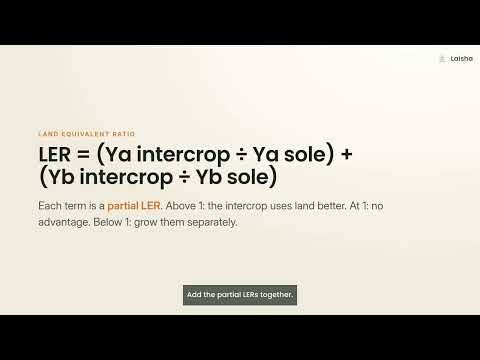
So how do you know whether an intercrop is worth it? With the land equivalent ratio, or LER. For each crop, divide its yield in the intercrop by its yield as a sole crop. That is its partial LER.
Add the partial LERs together.
A worked example.
Sole maize yields six tonnes per hectare, and sole beans two. The intercrop yields four point eight tonnes of maize and zero point nine of beans.
Maize: four point eight divided by six is zero point eight.
Beans: zero point nine divided by two is zero point four five.
The LER is one point two five.
That means you would need one point two five hectares of sole crops, zero point eight of maize and zero point four five of beans, to match one hectare of intercrop.
Above one, the intercrop uses land more efficiently.
At one, there is no advantage.
Below one, grow them separately.
Large reviews of field experiments around the world have found average LERs of roughly one point two to one point three for cereal and legume intercrops, with wide variation.
Read an LER honestly.
The sole crops must be grown at their best density and management, or the ratio is inflated.
If one crop holds the land much longer, the LER can exaggerate the gain.
And farmers compare money, not tonnes. The monetary advantage is the intercrop's value, times the LER minus one, divided by the LER. An intercrop worth one thousand currency units per hectare, with an LER of one point two five, gains one thousand times zero point two five, divided by one point two five: two hundred units over sole cropping. The partial LERs also show the balance: in our example, the taller maize kept eighty per cent of its sole yield,
and the shaded beans forty-five.
If beans are worth more, a different design may be better.
To design one, choose complementary crops: different heights, rooting depths or durations, or a legume with a non-legume. Decide whether the second crop replaces rows of the first, or is added to its full stand when the main crop must not lose yield.
Choose row ratios, such as one to one or two to two, so the shorter crop is not shaded all its life. Stagger sowing if one crop would swamp the other early. And fertilise for both: the legume's nitrogen does not fully replace the cereal's needs.
One more number: cropping intensity, the gross cropped area divided by the net cropped area, times one hundred. A one-hundred-hectare farm sows all of it in the wet season,
sixty hectares again in the dry season with irrigation,
and twenty hectares with a short pulse crop before the next wet season. The gross cropped area is one hundred and eighty hectares,
so the cropping intensity is one hundred and eighty per cent. Irrigation is usually what lifts it above one hundred in seasonally dry climates.
To recap.
Monoculture builds up pests, weeds and nutrient drain.
Rotate exhausting crops with legumes, deep roots with shallow ones, and never follow a crop with its own family.
Rotation raises yields mainly by breaking soil-borne pests and diseases.
Count the legume's nitrogen credit, based on local evidence. In intercrops, add the partial LERs: above one, the mixture uses land better.
Compare with well-grown sole crops, check the money, and design for light, timing and both crops' nutrition.
For the full guides and worked sums, visit laisha.ai.
And before you go: Laisha Lens number one is out, our free guide to November, for every climate zone on Earth.
North of the equator, the cool-season crops go in:
winter wheat and garlic in the temperate north,
wheat, barley and lentil on the autumn rains of the Mediterranean,
and on the plains of South Asia the whole rabi season,
wheat, mustard, chickpea and potato.
South of the equator it is spring, and the tropical south sows soybean, maize, cotton and rice on the first rains.
Lens also covers crop residue without fire, the pests worth walking the field for, and a study plan for agri students.
Open My farm's November, choose your zone and up to three crops, and it builds your field jobs, week by week, with the pests to scout for. It is free, and needs no account. Our free November Lens, with your farm's month plan, is on laisha.ai slash lens.
From all of us at Laisha: may your fields do well this season. Thank you for watching.
Last updated · How Laisha writes and checks its pages · Report a mistake
Go further with Laisha Smarter
US$10 a month · one price worldwide · cancel any time
- Ask Laisha about what you watched — up to 1,000 questions a month
- Your own crop calendar and pest alerts
- Every calculator and tool